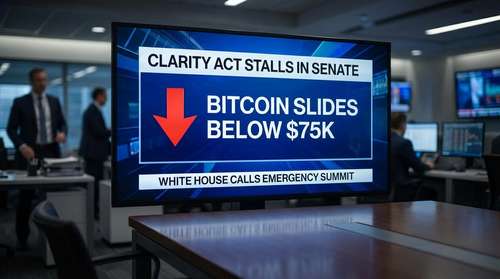
Washington, D.C. — The highly anticipated Clarity Act 2026, legislation poised to define the future of the U.S. crypto market structure, has hit a critical legislative wall in the Senate, triggering a sharp sell-off across digital asset markets. As Bitcoin (BTC) slides below $75,000 for the first time since the 2024 election cycle, the White House has announced an emergency summit to break the deadlock between banking lobbyists and tech leaders.
Clarity Act 2026 Hits a Senate Roadblock
The legislative impasse centers on a fierce dispute regarding stablecoin yield mechanisms—a conflict that led Coinbase CEO Brian Armstrong to withdraw his support for the bill late last week. The Clarity Act 2026, intended to build upon the foundation laid by last year's GENIUS Act, was expected to sail through the Senate Banking Committee. Instead, it has been halted by a coalition of traditional financial institutions arguing that the bill’s provisions for decentralized finance (DeFi) protocols create an uneven playing field.
“We are witnessing a classic tug-of-war between the old guard and the new economy,” said James Butterfill, head of research at CoinShares. “The withdrawal of support from major industry players like Armstrong signals that the current version of the bill may be too compromised to pass. The market hates uncertainty, and right now, Washington is delivering it in spades.”
The Stablecoin Yield Dispute
At the heart of the disagreement is the integration of the GENIUS Act stablecoin compliance standards. While the GENIUS Act (passed July 2025) strictly regulated stablecoin issuance, the new Clarity Act attempts to define how these assets can generate yield for holders. The American Bankers Association (ABA) has lobbied aggressively against allowing non-bank crypto platforms to offer interest-bearing stablecoin products, citing safety and soundness concerns. Conversely, crypto advocates argue that restricting yield stifles American innovation and drives capital offshore.
Bitcoin Price Dip February 2026: The Warsh Effect
Compounding the regulatory anxiety is the Bitcoin price dip February 2026, which has seen the flagship cryptocurrency shed over 15% of its value in just 72 hours. While the legislative stall is a major factor, market analysts point to a second catalyst: President Trump's nomination of Kevin Warsh as the next Federal Reserve Chair.
Nominated on Friday to succeed Jerome Powell, Warsh is viewed by Wall Street as a monetary hawk and a staunch defender of Fed independence. His nomination has triggered a broad "risk-off" rotation in global markets.
- Market Reaction: Investors rushed to liquidity, selling off gold, silver, and digital assets.
- Fed Policy Outlook: Warsh’s track record suggests a resistance to the "easy money" policies that often fuel crypto rallies.
- Confirmation Battles: The Senate Banking Committee has indicated it may delay Warsh’s confirmation pending the resolution of ongoing DOJ investigations, adding another layer of uncertainty.
“The nomination of Kevin Warsh as Fed Chair was a wake-up call,” noted a senior strategist at Fidelity Digital Assets. “The market was pricing in a more dovish successor. Warsh brings credibility, but he also brings a tighter monetary philosophy that is currently headwinds for Bitcoin.”
Emergency White House Crypto Summit
Facing a dual crisis of crashing markets and stalled legislation, the administration has summoned tech executives and banking leaders to a White House crypto summit scheduled for early next week. Sources close to the matter confirm that the meeting will be mediated by the White House Crypto Council.
The guest list reportedly includes top brass from the ABA, executives from the Blockchain Association, and CEOs from major exchanges. The goal is explicit: broker a compromise on the stablecoin yield provision to revive the Clarity Act before the mid-term election cycle fully takes over the legislative calendar.
“The administration is keen to get this done,” said Cody Carbone, CEO of The Digital Chamber. “They understand that leaving the crypto market structure bill in limbo undermines the President's promise to make America the crypto capital of the world. We expect a frank and difficult conversation, but a necessary one.”
Digital Asset Regulation News: What’s Next?
As the industry looks toward the summit, the stakes for digital asset regulation news have never been higher. If the Clarity Act fails to pass this session, the U.S. risks falling behind jurisdictions like the EU and Singapore, which have already finalized their comprehensive frameworks.
For investors, the immediate focus remains on the $72,000 support level for Bitcoin. A failure to hold this line could signal a deeper correction, while a positive outcome from the White House meetings could provide the catalyst needed for a sharp reversal. All eyes are now on Washington to see if the gridlock can be broken.