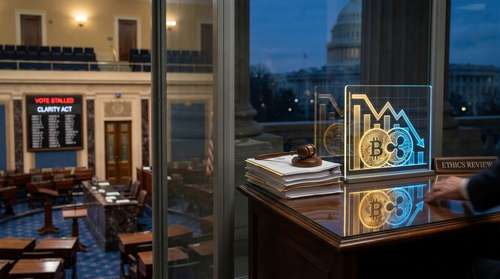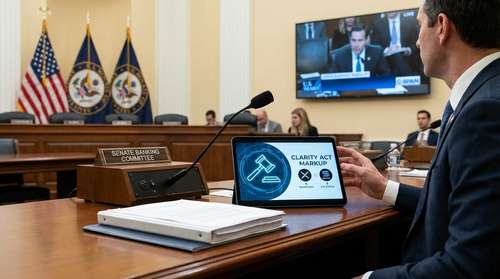
(April 13, 2026) — The United States digital asset industry has arrived at its most critical legislative crossroads to date. As lawmakers return from their Easter recess today, the Senate Banking Committee has officially commenced its highly anticipated markup of the Digital Asset Market Clarity (CLARITY) Act. Also known as H.R. 3633, this landmark legislation is poised to rewrite the rules of digital finance, replacing years of administrative hostility with a definitive framework for crypto regulation 2026.
The timing of this CLARITY Act Senate markup could not be more pivotal. Following the Securities and Exchange Commission's recent, sweeping review of 91 spot crypto ETF applications, traditional financial institutions are waiting for the final green light that only statutory certainty can provide. By permanently codifying the regulatory boundaries between federal agencies, the bill is expected to cement the commodity status of major altcoins, clearing the runway for unprecedented market expansion and keeping digital asset innovation on American soil.
Drawing the Line: SEC versus CFTC Jurisdiction
For years, U.S. blockchain businesses have operated under a cloud of "regulation by enforcement," a dynamic that has routinely pushed domestic talent offshore. The CLARITY Act dismantles this punitive approach by drawing a hard statutory line across the financial sector.
Under the current committee draft, the Commodity Futures Trading Commission (CFTC) will gain exclusive jurisdiction over "digital commodity" spot markets. The agency will utilize a principles-based framework focused heavily on market integrity, trade surveillance, and capital requirements for digital commodity exchanges. Conversely, the SEC retains its disclosure-based mandate over "investment contract assets," ensuring that tokens representing literal stakes in business enterprises remain subject to traditional securities laws.
Preemptive Agency Alignment
The foundation for this transition is already being laid by the regulators themselves. On March 17, the SEC and CFTC issued a joint interpretive release preemptively naming over a dozen top assets—including XRP, Ethereum, and Solana—as digital commodities. The ongoing markup by the Senate Banking Committee digital assets leadership seeks to lock this classification into federal statute, making it reversible only by a literal act of Congress.
Accelerating Institutional Crypto Adoption
This legislative momentum directly impacts the immediate product pipelines of Wall Street's largest asset managers. The SEC is currently evaluating a staggering 91 spot crypto exchange-traded fund applications, a backlog caused largely by jurisdictional hesitation. A major sticking point in previous years was the ambiguous legal standing of alternative layer-one tokens.
With the CLARITY Act effectively locking in the Solana commodity classification alongside Bitcoin and Ethereum, the regulatory friction that stalled previous multi-asset fund launches is evaporating. Consequently, the spot XRP ETF approval status is now inextricably linked to the successful passage of this bill. If the legislation clears the Senate floor, asset managers will finally possess the undisputed legal certainty required to launch diversified crypto index products. This shift from legal ambiguity to statutory clarity is widely viewed as the exact catalyst required to trigger the next massive wave of institutional crypto adoption.
The Sticking Point: Stablecoin Yield and DeFi Protections
While the bill enjoys broad bipartisan momentum—having passed the House 294-134 in July 2025 and cleared the Senate Agriculture Committee earlier this year—the banking committee markup will not be without friction.
Lawmakers are currently clashing over controversial provisions surrounding stablecoins. Draft compromises circulated in late March indicate a significant legislative trade-off: non-custodial decentralized finance (DeFi) protocols and self-hosted smart contracts will be explicitly shielded from being treated as deposit-taking institutions.
However, this vital DeFi protection comes at a severe cost for centralized entities. Digital asset service providers and stablecoin issuers would be strictly prohibited from offering yield on passive stablecoin balances. This specific restriction has drawn fierce pushback from major industry players like Stripe and Coinbase. These firms argue that banning stablecoin rewards limits consumer benefits and artificially protects legacy community banks from fair market competition. Negotiators will spend the coming days hammering out amendments to bridge this divide.
The Path Forward for U.S. Crypto Bill News
Chairman Tim Scott and committee leaders are moving with urgency to advance the unified text out of the banking committee before the end of April. If the markup process succeeds without fatally fracturing the bipartisan coalition, lawmakers are targeting a full Senate floor vote by mid-May 2026.
The political stakes are enormous. Failure to pass the legislation before the summer recess could push the framework into the chaotic vortex of the upcoming mid-term elections, potentially delaying regulatory clarity for another year.
As the U.S. crypto bill news cycle accelerates, global markets remain fixated on Capitol Hill. The amendments debated by the Senate Banking Committee over the next two weeks will dictate whether the United States reclaims its position as the undisputed hub for blockchain technology, or whether regulatory infighting will continue to stifle the financial future.