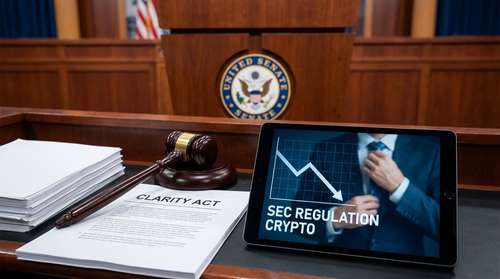

American retirement portfolios are standing on the precipice of a monumental shift. On March 30, 2026, the U.S. Department of Labor officially proposed a sweeping regulatory framework that paves the way for a major 401(k) crypto investment expansion. Titled "Fiduciary Duties in Selecting Designated Investment Alternatives," the draft rule fundamentally alters how employers can structure workplace savings. By establishing a clear legal pathway for integrating alternative assets, the government is essentially ending years of regulatory roadblocks, marking a watershed moment for decentralized finance intersecting with traditional Wall Street mechanics.
Reversing Course: The Trump Administration Crypto Policy
The newly introduced framework stems directly from a broader deregulatory push and an August 2025 executive order directing federal agencies to democratize access to alternative investments. For years, financial providers hesitated to include digital currencies in defined contribution plans. This cautious approach was heavily influenced by a 2022 compliance release from the previous administration, which bluntly warned plan fiduciaries to exercise "extreme care" due to perceived fraud and volatility risks.
Today, the Trump administration crypto policy flips that script entirely. By treating Department of Labor digital assets on par with private equity, commodities, and real estate, the current leadership is pushing for unprecedented portfolio diversification. Labor Secretary Lori Chavez-DeRemer emphasized the shift this week, stating that the proposal will demonstrate how savings plans can consider products reflecting today's modern investment landscape, characterizing the move as a major victory for American workers seeking to maximize their nest eggs.
A New Safe Harbor for Retirement Fund Cryptocurrency
Historically, the massive $13.8 trillion defined-contribution market remained virtually closed off to alternative assets. This was not strictly out of legislative prohibition, but rather due to the looming threat of class-action lawsuits. Employers feared breaching their strict fiduciary duties under the Employee Retirement Income Security Act (ERISA) if an unconventional asset underperformed.
To mitigate this friction, the DOL's framework introduces a much-needed "safe harbor" mechanism. Plan managers who objectively and analytically evaluate six distinct factors—performance, fees, liquidity, valuation, benchmarking, and the complexity of the designated asset—will be afforded significant legal deference. If fiduciaries follow this meticulous roadmap, they are largely shielded from litigation regarding retirement fund cryptocurrency volatility.
Market Reactions and Pushback
While asset managers view the explicit criteria as the green light they needed to begin structuring compliant offerings, the proposal has not been without its detractors. Consumer protection advocates and certain lawmakers have quickly pushed back, arguing that the safe harbor could incentivize financial advisers to pitch highly volatile products to unsuspecting workers. Despite these concerns, proponents argue the potential long-term financial returns justify the trade-offs, especially in an era of persistent inflation.
Regulatory Synergy and CLARITY Act Crypto News
The Labor Department's announcement does not exist in a vacuum; it aligns seamlessly with aggressive legislative momentum playing out on Capitol Hill. Most notably, recent CLARITY Act crypto news suggests a comprehensive market structure is imminent.
Passed by the House last summer and currently undergoing heated markup sessions in the Senate Banking Committee, the Digital Asset Market Clarity (CLARITY) Act of 2025 aims to definitively divide regulatory oversight between the SEC and the CFTC. Progress on the bill has been rapid in recent days. Just this week, Coinbase Chief Legal Officer Paul Grewal indicated that compromises regarding stablecoin yields could see the legislation finalized shortly, spurred by executive pressure to establish clear operational rules. The simultaneous advancement of both a DOL safe harbor and the CLARITY Act paints a picture of a comprehensively regulated environment finally materializing for digital commodities.
Fueling Institutional Crypto Adoption 2026
Unlocking workplace retirement accounts represents perhaps the largest untapped liquidity pool for the blockchain sector. Major financial players are already positioning themselves to capitalize on the incoming wealth transfer. With titans of traditional finance actively developing bespoke investment products for defined-contribution plans, the infrastructure required to support these options is scaling rapidly.
The integration of robust digital asset retirement options will not happen overnight. The proposed rule now enters a mandatory public comment period ending June 1, 2026, followed by final agency reviews and highly probable legal challenges. However, the foundational psychological barrier has undeniably been broken.
Institutional crypto adoption 2026 is no longer just about specialized hedge funds or corporate treasuries holding Bitcoin on their balance sheets; it is about the everyday employee seamlessly allocating a percentage of their bi-weekly paycheck into digital assets. As the traditional and decentralized financial systems continue to merge, millions of Americans are poised to gain unprecedented control over the diversification of their financial futures.