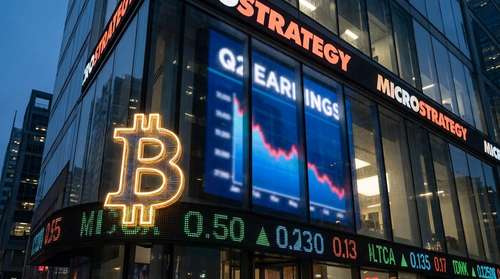
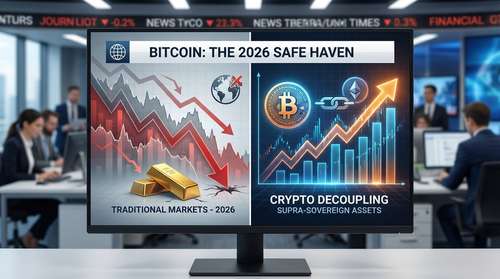
As the escalating US-Iran conflict enters its volatile sixth week, the global financial landscape is experiencing a seismic shift. While global equities and physical commodities crumble under the weight of geopolitical anxiety, digital assets are rewriting the rules of wealth preservation. The reality of a Bitcoin safe haven 2026 is no longer a speculative theory but an undeniable market dynamic. Traders are witnessing an unprecedented crypto market decoupling, with digital currencies showcasing extraordinary resilience against widespread macroeconomic fallout.
The Great Disconnect: Crypto Market Decoupling in Real Time
For decades, investors instinctively fled to government bonds and precious metals at the first sign of military escalation. Today, capital flows tell a radically different story. While the S&P 500 has retreated by 8% since the hostilities began and the VIX volatility index spiked to 35, digital assets have absorbed the geopolitical shockwaves with remarkable fortitude.
The highly anticipated Bitcoin price $70k milestone is once again being tested, bolstered by reports of regional mediators pushing a 45-day ceasefire to reopen the crucial Strait of Hormuz. The premier cryptocurrency surged over 4% to reclaim the $69,800 territory, triggering a massive short squeeze. Over the past 24 hours, more than $342 million in leveraged crypto bets were liquidated, the vast majority being short positions held by traders who bet against the asset's underlying strength.
This aggressive rebound occurs despite Brent crude oil climbing 36% to hover near $112 per barrel, a surge that threatens to push US inflation to 3.7%. Instead of buckling under the pressure of rising energy costs, the total cryptocurrency market capitalization actually expanded by 1.8% to $2.39 trillion throughout March. This continuous, round-the-clock liquidity profile proves invaluable during global emergencies that routinely disrupt traditional trading hours and physical supply chains.
Ethereum vs Gold Performance Rewrites the Playbook
Perhaps the most striking development of the current Middle Eastern crisis is the stark divergence between physical and digital commodities. A closer examination of Ethereum vs Gold performance reveals a fundamental transfer of institutional trust away from legacy safe havens.
Since the outbreak of the conflict, gold has plunged 13%, suffering an estimated $11 billion in ETF outflows over a three-week period. Silver fared even worse, erasing 22% of its value as rising interest rates and a strengthening US dollar crushed heavily crowded traditional positions. Market analysts point out that gold's liquidity has severely deteriorated during this conflict, trapping capital when investors need flexibility the most.
In sharp contrast, Ethereum has gained a steady 6% over the same wartime stretch—peaking at a massive 22% upside—while spot Bitcoin ETFs recorded roughly $1.2 billion in net inflows. Digital assets are increasingly viewed by corporate treasuries and institutional funds as supra-sovereign assets. These borderless stores of value remain completely immune to physical supply chain blockades, shipping route closures, and localized economic collapse.
How the SEC CFTC Crypto Taxonomy Calmed the Markets
The blockchain sector's current strength isn't solely driven by geopolitical fear; it is heavily anchored by a watershed regulatory breakthrough. On March 17, federal regulators jointly released the long-awaited SEC CFTC crypto taxonomy, fundamentally altering the institutional investment landscape in the United States.
Led by SEC Chairman Paul Atkins and the CFTC, this comprehensive interpretive guidance classified tokens into five distinct categories: digital commodities, digital collectibles, digital tools, stablecoins, and digital securities. By explicitly acknowledging that certain digital commodities fall outside restrictive securities laws and transferring their oversight to commodity frameworks, the agencies provided the exact legal clarity Wall Street required.
Institutional funds that previously hesitated to enter the digital space are now deploying capital with absolute confidence. This unified federal framework arrived perfectly on time, giving asset managers the legal grounding they needed to pivot toward cryptocurrencies precisely when traditional equities began to stumble under war-time pressure.
The New Era of Geopolitical Crypto News
The events unfolding in early April 2026 mark a critical maturation point for decentralized finance. We are rapidly transitioning from an era where cryptocurrencies moved strictly as high-beta technology stocks into a paradigm where they serve as a distinct, unshakeable asset class.
Tracking geopolitical crypto news has become essential for modern macro traders. Digital currencies now respond to diplomatic developments—such as the ongoing US-Iran ceasefire negotiations and potential infrastructure strikes—with real-time price discovery that legacy markets simply cannot match.
Whether the proposed 45-day ceasefire materializes or regional tensions escalate further, the structural shift in global finance is already cemented. The outdated narrative of digital currencies as volatile, purely speculative experiments has been decisively dismantled. In the face of a sinking traditional economy, the decentralized ecosystem stands alone as a functional, liquid sanctuary.