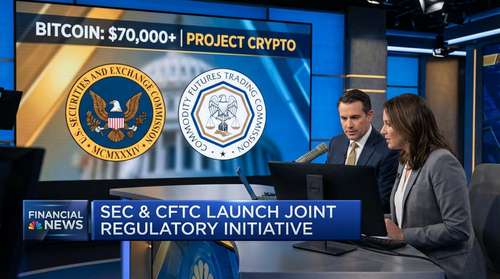
Bitcoin has staged a dramatic recovery, reclaiming the psychological $70,000 stronghold to trade at $70,512 as of Sunday morning. The resurgence follows a brutal 48-hour "cleansing phase" that saw nearly $875 million in leveraged positions liquidated amidst new global trade tariff anxieties. This price action coincides with a watershed moment for U.S. digital asset policy: the operational launch of "Project Crypto," a joint regulatory initiative between the Securities and Exchange Commission (SEC) and the Commodity Futures Trading Commission (CFTC).
Bitcoin Price Recovery February 2026: The 'Extreme Fear' Bounce
The crypto market's resilience was tested late last week as Bitcoin plummeted toward $60,000, driven by macro fears surrounding the administration's new trade tariffs. However, the dip was aggressively bought up by retail and institutional investors alike, triggering a "V-shaped" recovery. Despite the bounce, the Crypto Fear & Greed Index remains entrenched in "Extreme Fear," signaling that while the Bitcoin $70k support level has held, market sentiment remains fragile.
"This was a classic leverage flush," notes a senior analyst. "The market needed to cleanse the over-leveraged longs accumulated in January. Reclaiming $70,000 so quickly suggests strong underlying demand, but we aren't out of the woods until we see a daily close above $75,000."
SEC Project Crypto Initiative: Ending the Turf War
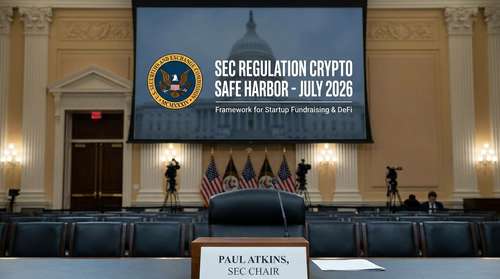
While price action dominates the headlines, the most significant long-term development is the official commencement of the SEC Project Crypto initiative. Spearheaded by Paul Atkins, SEC Chairman, and his counterpart at the CFTC, Michael Selig, this initiative aims to finally harmonize the fragmented U.S. regulatory landscape.
For years, the industry has been plagued by jurisdictional disputes—often described as "turf wars"—between the two agencies. Project Crypto seeks to end this by establishing a unified legal taxonomy for digital assets. The goal is to clearly define which assets are securities, which are commodities, and which fall into a new hybrid category.
Key Objectives of Project Crypto
- Unified Taxonomy: A joint definition framework to eliminate the "regulation by enforcement" approach of the past decade.
- Operational Efficiency: Streamlining registration processes for exchanges that list both crypto securities and commodities.
- Innovation Exemption: A proposed "safe harbor" period for decentralized projects to mature before facing full compliance burdens.
SEC CFTC Regulatory Harmony: A 'Shad-Johnson' Moment?
Industry insiders are calling this the most important regulatory development since the 1982 Shad-Johnson Accord, which resolved jurisdictional conflicts over stock index futures. SEC CFTC regulatory harmony is crucial for bringing institutional capital back off the sidelines.
Chairman Atkins emphasized in a statement this weekend that "Project Crypto represents a shift from adversarial oversight to cooperative modernization." This sentiment was echoed by CFTC Chair Selig, who highlighted the need for "minimum-effective-dose regulation" that protects investors without stifling the technological edge of the United States.
Market Outlook: Liquidations and Support Levels
The recent volatility cannot be ignored. The crypto market liquidations in 2026 have already surpassed 2025's Q1 totals, with this weekend's $875 million wipeout serving as a stark reminder of the risks. Traders should watch the $68,500 level closely; a break below this could re-trigger the "falling knife" scenario.
Conversely, if U.S. crypto regulation news today continues to be positive regarding the execution of Project Crypto, Bitcoin could target the $78,000 resistance zone next. The market is currently pricing in a "regulatory premium," anticipating that a clearer rulebook will eventually lead to a new wave of ETF inflows and corporate treasury adoption.
Conclusion
As Bitcoin fights to consolidate above $70,000, the launch of Project Crypto offers a fundamental backstop that was missing in previous cycles. For the first time, the two most powerful U.S. financial regulators are moving in lockstep, potentially setting the stage for a more mature, stable, and compliant crypto market in 2026.