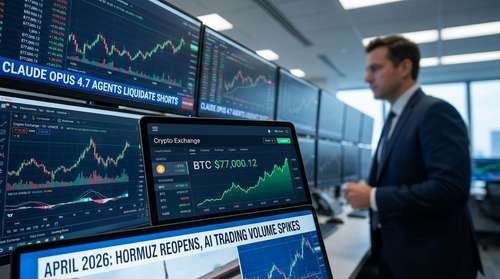
The cryptocurrency market is experiencing a historic paradigm shift this week. Bitcoin shattered a multi-month consolidation pattern to hit $77,124 [1], driven by an unprecedented collision of macro-economic relief and breakthrough financial technology. The Bitcoin price rally April 2026 was ignited by sudden geopolitical de-escalation in the Middle East [1], but the momentum is currently being supercharged by a new class of autonomous market participants.
The Macro Catalyst: Strait of Hormuz Reopening Impact
Geopolitical tensions had held risk assets hostage since late February. When commercial shipping lanes were effectively shut down, Brent crude spiked well past $100 per barrel, dragging inflation metrics higher and forcing the Federal Reserve into a hawkish corner. That gridlock ended definitively on Friday [1].
The Strait of Hormuz reopening impact was immediate and dramatic across global markets [1]. As commercial vessels resumed transit through the vital chokepoint—which handles roughly 20% of the world's petroleum supply—crude oil prices crashed 11%, settling at $85.90 per barrel [1].
This global oil price drop crypto correlation cannot be overstated [1]. Bitcoin has traded with an 85% correlation to the Nasdaq during recent oil spikes, tying its price directly to broader risk-asset flows [1]. March's stubborn 3.3% Consumer Price Index print was overwhelmingly energy-driven, while core CPI came in much cooler at 2.6% [1]. With oil plunging back below the $90 threshold, the inflation narrative is rapidly deteriorating [1]. Markets are aggressively repricing the likelihood of a looser monetary policy heading into the FOMC's late-April meeting. When systemic liquidity expectations improve, capital flows straight back into high-beta assets.
AI Takes the Wheel: Claude Opus 4.7 Crypto Trading
While falling energy prices provided the fundamental runway, a massive technological leap fueled the breakout. Anthropic just deployed its latest flagship model, introducing Claude Opus 4.7 crypto trading capabilities to the open market.
This isn't a simple price tracker or advisory bot. Opus 4.7 is the first top-tier artificial intelligence capable of autonomously managing decentralized finance positions round-the-clock. Utilizing the newly expanded Coinbase AgentKit AI wallets, these agents are operating natively on the Base layer-2 network to execute trades, capture yield, and rebalance portfolios without human intervention [1].
The AgentKit framework relies on the x402 payment protocol, a system purpose-built for machine-to-machine economies that has already processed tens of millions of transactions [1]. It effectively grants Claude Opus 4.7 its own onchain identity and capital access. For example, if a localized yield opportunity opens at 3:00 AM, the agent detects it, acquires the necessary API keys, and rebalances the portfolio instantly based on pre-set user permissions [1]. Retail and institutional traders alike are racing to deploy these autonomous agents, creating a persistent, algorithmic bid beneath the market.
The Rise of the Machine Economy
The implications of this technology extend far beyond simple spot trading. By integrating with the Bitcoin Lightning Network using the L402 standard, these agents can now run independent nodes and manage native BTC wallets [1]. This creates a self-sustaining ecosystem where AI pays for its own compute power, storage, and premium data streams using cryptocurrency [1]. The market is pricing in the reality that billions of micro-transactions will soon be handled entirely by autonomous programs, dramatically expanding network utility.
The Derivatives Trap: BTC Short Squeeze Liquidations
Derivatives markets were positioned for continued stagnation. Heavy leverage had accumulated during the six-week oil crisis, with over $6 billion in short contracts clustered tightly between $72,200 and $73,500 [1]. The sudden convergence of tumbling oil and the Claude Opus launch caught these bears completely off guard.
As spot demand absorbed available supply over the weekend, the market triggered cascading BTC short squeeze liquidations. When Bitcoin breached the heavy resistance band, it forced short sellers to automatically buy back their positions to cover losses. This mechanical buying pressure created a violent upside vacuum, propelling the asset directly past $75,000 and culminating in the local top of $77,124 [1]. Exchange data shows that bears lost billions in mere hours, clearing the order book of overhead friction.
Is the Bitcoin $80k Price Prediction Inevitable?
The landscape has fundamentally changed from just one week ago. The energy-driven inflation tax that suppressed risk appetite is evaporating. Simultaneously, the introduction of autonomous AI capital management represents a structural shift in how cryptocurrency is traded and held.
As traders look toward the upcoming Federal Reserve meeting, the Bitcoin $80k price prediction has shifted from a long-term target to a near-term probability. Technical analysts point out that Bitcoin has comfortably cleared its 200-day moving average, a critical threshold separating bearish trends from bull markets.
Institutions are already positioning themselves for this reality. Spot ETF inflows are stabilizing, and the AI-driven volume on layer-2 networks shows no signs of slowing down. Bitcoin has transitioned from absorbing macro shocks to capitalizing on them, leaving the $80,000 threshold as the next major technical battleground.