
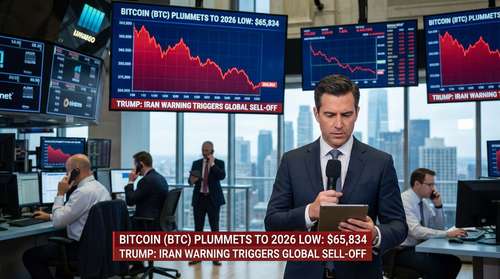
The global financial landscape is reeling today following a stark geopolitical escalation that triggered a massive flight from risk assets. In the most severe Bitcoin price crash 2026 has seen so far, the flagship cryptocurrency plummeted to a yearly low of $65,834. The aggressive sell-off was sparked late Thursday night when President Trump delivered a primetime address, vowing to strike Iran "extremely hard" in response to ongoing Middle Eastern tensions. Instead of seeking refuge in digital assets, investors aggressively dumped their crypto holdings, completely upending the narrative that decentralized currencies act as an automatic safe haven during international military conflicts.
As the dust settles on Wall Street and trading desks across Asia and Europe process the news, the fallout is becoming unmistakably clear. We are witnessing a textbook liquidation cascade driven by macro panic rather than any fundamental failure within the blockchain ecosystem itself.
The Geopolitical Impact on Bitcoin and Traditional Markets
The immediate aftermath of the Trump Iran speech crypto market reaction illustrates exactly how intertwined digital assets have become with global macroeconomic levers. When the commander-in-chief signaled impending military action, the immediate shockwave sent Brent crude oil prices soaring past $106 a barrel, with WTI crude jumping above $113. This sudden spike in energy costs reignited fears of sticky inflation and forced institutional investors to drastically de-risk their portfolios across the board.
Historically, proponents have argued that Bitcoin operates outside the purview of traditional nation-state conflicts. However, the severe geopolitical impact on Bitcoin over the last 48 hours proves that algorithmic scarcity alone cannot offset raw investor panic. When the threat of war looms, liquidity is king. Traders who had heavily leveraged long positions found themselves rapidly underwater as exchanges automatically closed positions to prevent cascading margin failures.
Crypto ETF Outflows News Signals Institutional Retreat
Perhaps the most telling indicator of Wall Street's anxiety is the swift reversal of institutional capital. According to the latest crypto ETF outflows news, spot Bitcoin exchange-traded funds hemorrhaged over $174 million in just a few hours following the presidential broadcast. This mass exodus represents a sharp break from the steady accumulation trend observed throughout the first quarter of the year.
These institutional products, initially championed as a stabilizing force for Bitcoin's price discovery, are now acting as a dual-edged sword. When retail and institutional sentiment aligns defensively, the liquidity drain through ETFs accelerates downward momentum much faster than the spot market drops of previous cycles. Asset managers are clearly hitting the pause button, pulling capital from high-beta tech and crypto assets while redeploying it into traditional defensive safe havens like short-term Treasuries.
Widespread Carnage: The Cryptocurrency Market Selloff Today
While Bitcoin's slide to $65,834 is capturing the major headlines, the cryptocurrency market selloff today is broad and punishing across the digital asset spectrum. Alternative coins, which typically carry higher volatility than Bitcoin, are absorbing the absolute brunt of the geopolitical shock.
The Ethereum price drop April 2026 is particularly brutal for decentralized finance participants. ETH tumbled nearly 5%, triggering over $94 million in cascading liquidations. Smart contract platforms are highly sensitive to network utility metrics, and an environment ruled by fear typically sees a stark decline in on-chain activity. Binance Coin (BNB) also faced aggressive downside pressure, wiping out millions in open interest. The leverage that had quietly built up in altcoin derivatives over the past few weeks acted as pure fuel for the fire once the initial Trump-induced panic set in.
Analyzing the Bitcoin 2026 Low $65k Target
Market structure analysts are now closely watching the order books around the Bitcoin 2026 low $65k zone. This specific threshold holds massive psychological and technical significance. Back in late 2024 and early 2025, the mid-$60k range served as a stubborn resistance level before flipping into a massive bedrock of support. Breaking below it on high volume would signal a fundamental shift in market momentum.
Right now, the multi-billion-dollar question is whether the institutional panic has exhausted itself or if this is just the first leg down in a prolonged geopolitical bear phase. If military action escalates further in the Persian Gulf and oil climbs toward $120 a barrel, retail traders alone will not be able to defend the $65,834 floor. High energy prices historically crush consumer discretionary spending, which directly chokes off the flow of retail capital into crypto exchanges.
The days of crypto trading in a vacuum are definitively over. As we navigate the second quarter of 2026, the digital asset market has firmly established itself as a hyper-sensitive barometer for global geopolitical stability. Until the White House clarifies the exact scope of its planned intervention in Iran, volatility will remain the only guarantee. For now, traders are keeping their powder dry, watching both the ticker tapes and the diplomatic wires with equal intensity.