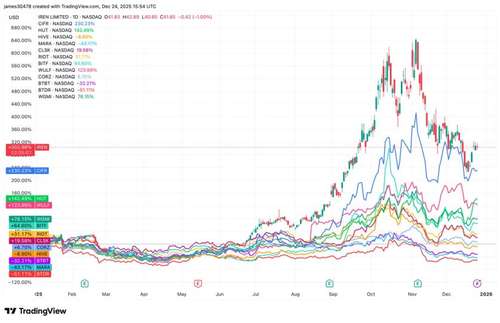
As 2025 concludes, the landscape of Bitcoin mining has undergone significant shifts, with clear winners and laggards emerging. Notably, Bitcoin faced a challenging year, with prices dipping by approximately 7% year-to-date, amid soaring performances in other sectors like gold and technology stocks. This price action has had a pronounced effect on public bitcoin mining stocks, revealing a stark contrast based on miners' strategies towards diversification.
The Rise of Diversified Miners
Central to this year's mining industry narrative is the success of companies embracing diversification, particularly into artificial intelligence (AI) and high-performance computing (HPC) infrastructures. Leading the pack is IREN (IREN), whose strategic pivot towards AI paid off with a remarkable +300% increase in year-to-date gains. This success was buoyed by significant GPU cloud deals and robust backing from Microsoft, underscoring the advantages of integration with technology giants.
Following closely is Cipher Mining (CIFR), which achieved a +230% gain. Cipher's collaborations, especially with Fluidstack for AI hosting partnerships, have proven fruitful. Equally impressive is Hut 8 (HUT), which boasts a +139% increase, largely attributed to its new $7 billion, 15-year AI data center lease agreement at its River Bend site in Louisiana.
Bitcoin Mining Laggards
While diversified miners thrived, pure-play bitcoin mining operators found themselves on the back foot. Marathon Digital (MARA), a major bitcoin holder among miners with 53,250 BTC, experienced a steep 44% decline. CleanSpark (CLSK), holding 13,011 BTC, and Riot Platforms (RIOT), with 19,324 BTC, managed modest gains of 16% and 32% respectively, although their AI diversification efforts came too late in the year to substantially benefit their performance.
Another notable underperformer, Bitdeer Technologies (BTDR), saw its value plummet by about 50%. The significant losses followed a disappointing Q3 earnings report that revealed a larger-than-expected net loss and delays in ASIC chip production, creating uncertainty around its AI expansion ambitions.
The Impact of AI and HPC Diversification
This year's developments have spotlighted a clear trend: miners who repurposed operations towards AI data centers significantly outperformed their counterparts focusing solely on bitcoin operations. This shift exemplifies the growing interdependence between cryptocurrency and advancing technologies such as AI and HPC. Core Scientific (CORZ), for instance, maintained independence following a rejected $9 billion all-stock takeover bid, betting on future value from AI demand, albeit gaining a modest 9% increase in shares.
The narrative of 2025, therefore, revolves around the strategic pivot towards diversification into sectors like AI, highlighting its crucial role in the financial health and future prospects of bitcoin mining companies. With bitcoin dipping below $87,000 and broader crypto markets declining, diversification might well be the key to resilience in the face of market volatility.
As the year wraps up, stakeholders within the Bitcoin mining industry are reflecting on a period of significant transformation. The lessons learned from this year's winners and laggards will likely shape strategies and investments as the industry heads into 2026, balancing the inherent volatility of cryptocurrency markets with the emerging opportunities in AI and HPC.