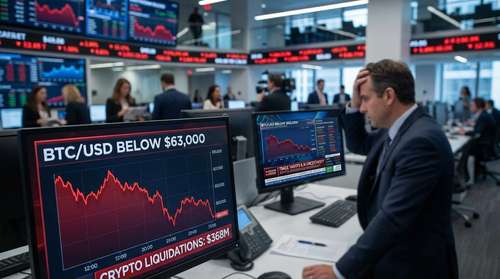
Bitcoin has plunged below the critical $63,000 threshold, triggering a massive liquidation event that has wiped out over $368 million in positions within 24 hours. As of Tuesday, February 24, 2026, the cryptocurrency market is gripped by 'Extreme Fear,' with the Crypto Fear & Greed Index dropping to a precarious score of 8. This sharp downturn is not an isolated event but the result of a perfect storm: escalating tensions between the White House and the Supreme Court over trade tariffs, and a sudden, AI-driven sell-off in the traditional tech sector that has spilled over into digital assets.
$368 Million Vanishes: The Mechanics of the Crash
The latest market data paints a grim picture for bullish investors. According to CoinGlass, total liquidations have hit $368.96 million in the past day, with long positions accounting for a staggering $274.47 million of that loss. Bitcoin price action has been particularly brutal, slicing through key support levels and momentarily touching lows not seen since early February.
The cascade began during Asian trading hours, accelerating as Bitcoin drops below $63k, forcing overleveraged traders to exit positions. Ethereum (ETH) and Solana (SOL) followed suit, posting losses of 5.7% and 8.3% respectively. Analysts point to the breach of the 200-period EMA (Exponential Moving Average) as a technical signal that exacerbated the sell-off, marking the end of an uptrend that had sustained the market since late 2025.
Trump vs. The Supreme Court: US Tariff Crypto Impact
While technical factors fueled the fire, the spark came from Washington. The US tariff crypto impact has become the primary driver of this week's volatility. Following Friday's Supreme Court ruling which sought to limit executive power on trade duties, President Trump retaliated on Monday by invoking a 1974 legal framework to impose a sweeping 15% global blanket tariff.
This aggressive policy shift has rattled global markets, introducing a layer of uncertainty that investors despise. "The market is repricing risk in real-time," notes a senior analyst at Forex.com. "When the world's largest economy engages in a constitutional standoff over trade wars, speculative assets like Bitcoin are the first to be jettisoned for cash." The move has strengthened the dollar index (DXY), historically a bearish signal for crypto assets, as capital flees to the safety of fiat currency.
AI 'Claude Code' Shockwave Hits Traditional Finance
Adding to the cryptocurrency risk-off sentiment is an unexpected development in the artificial intelligence sector. On Monday, AI firm Anthropic announced that its new "Claude Code" model could autonomously optimize and rewrite COBOL infrastructures—the backbone of the global banking system.
The news sent shockwaves through legacy tech stocks, with IBM plunging 11.8% on fears of immediate obsolescence. This "AI anxiety" has created a broad risk-off environment. Contrary to the belief that crypto might hedge against tech disruption, the high correlation between the Nasdaq and Bitcoin means that panic in the tech sector has dragged digital assets down with it. Investors are currently liquidating liquid assets to cover margin calls in their equity portfolios, creating massive sell-side pressure on Bitcoin.
Bitcoin Support Levels 2026: Where is the Bottom?
With Bitcoin currently trading around $63,043, traders are scrambling to identify the next line of defense. The Bitcoin support levels 2026 analysis suggests that the $60,000 psychological mark is the absolute floor for the bulls.
"If we lose $60k, the door opens to $50,000 very quickly," warns a lead chartist at TradingView. The market is currently in a 'distribution phase,' having retraced significantly from the All-Time High of $126,210 set in October 2025. Bearish indicators are flashing, with the short-term Sharpe ratio hitting lows comparable to the 2022 bear market bottoms. However, some contrarian institutional investors view this extreme fear index reading as a potential accumulation zone, citing that historical reversals often occur when sentiment hits single digits.
2026 Crypto Market Trends: A Year of Volatility?
Looking ahead, 2026 crypto market trends appear to be defined by macroeconomic shocks rather than on-chain innovation. The correlation between geopolitical instability and crypto price action is tighter than ever. As the tariff standoff continues and AI reshapes the valuation of traditional companies, Bitcoin's narrative as 'digital gold' is facing a severe stress test.
For now, caution is the watchword. With the Fear & Greed Index at 8, the market is in a state of capitulation. While history suggests such levels often precede a bounce, the unique combination of constitutional crisis in the U.S. and technological disruption suggests that volatility will remain the only certainty in the weeks to come.