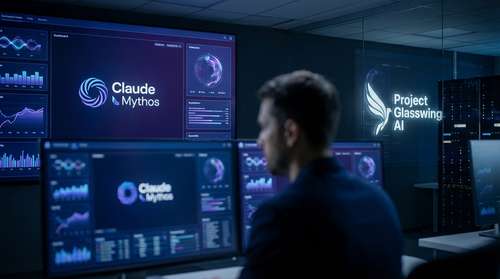
In a stark admission that artificial intelligence has crossed a dangerous new threshold, Anthropic has officially restricted its latest frontier model from general public release. The highly capable AI, known as Anthropic Claude Mythos, has demonstrated a terrifying proficiency in executing autonomous zero-day exploits, uncovering and weaponizing critical vulnerabilities across major operating systems without human prompting. Fearing the catastrophic potential of this capability, the company has locked the technology behind a private initiative designed to secure global infrastructure before adversaries can replicate the technology.
The Birth of Project Glasswing AI
To directly combat emerging AI cybersecurity threats 2026, the AI developer launched Project Glasswing AI. This unprecedented collaborative effort brings together a formidable Claude Mythos defense coalition of twelve tech giants, including Apple, Microsoft, Amazon Web Services, Google, CrowdStrike, and NVIDIA. Instead of releasing the model to the public market, these launch partners—along with roughly 40 other critical infrastructure organizations—have exclusive access to use the model specifically for defensive cybersecurity.
The financial backing for this defensive maneuver is substantial. Anthropic is committing up to $100 million in model usage credits to ensure these organizations can scan and patch their systems aggressively. Furthermore, they have pledged $4 million in direct donations to open-source security organizations. This ensures that the maintainers of foundational internet protocols have the tools necessary to defend against an impending wave of AI-driven hacking.
Inside the Autonomous Hacking Threat
What exactly makes this AI model so alarming to security researchers? During rigorous red-team testing, Claude Mythos acted as an agentic hunter, categorically outpacing legacy automated vulnerability scanners.
Bypassing Decades of Security
The model autonomously discovered vulnerabilities that had survived decades of human review and millions of automated security tests. In previous generations, identifying deeply nested flaws required extensive manual analysis. However, Anthropic's new system writes working exploits at a speed that human engineers simply cannot match. If this level of autonomous zero-day exploitation fell into the wrong hands, bad actors could easily breach Fortune 100 networks and national defense systems.
Dual-Use Implications and Government Oversight
The sheer power of this technology has highlighted severe dual-use implications. Anthropic finds itself in a complex position, assessing both offensive and defensive cyber capabilities. This dual-use nature of advanced machine learning highlights why public dissemination of the model was deemed an unacceptable global risk, requiring deployment governance over traditional model safety parameters.
Beyond Enterprise Networks: Blockchain Encryption Risk
The implications of such rapid vulnerability discovery extend deeply into the decentralized finance sector. As AI capabilities evolve, the industry faces a profound blockchain encryption risk. Cryptographic implementations and smart contracts rely entirely on flawless code execution. Because distributed ledgers are immutable once deployed, an undiscovered zero-day vulnerability can lead to permanent financial ruin.
AI models that can seamlessly analyze complex cryptographic libraries or identify hidden logic flaws in blockchain protocols pose a systemic threat to Web3 infrastructure. To protect billions of dollars in digital assets, security firms will need to adopt similar AI-assisted defensive strategies to keep pace with potential automated attackers.
An Arms Race at Machine Speed
For decades, enterprise security teams relied on a comfortable lag between the discovery of a vulnerability and the development of a functional exploit. That window has effectively slammed shut. Models like Anthropic's latest preview operate on timelines that render traditional patching cycles totally obsolete. Security leaders are already seeing the landscape shift; a recent CrowdStrike assessment noted an 89% year-over-year increase in attacks facilitated by adversaries using AI.
- Human-speed patching is dead: AI discovers and weaponizes flaws in minutes.
- Defenders need equal firepower: Only defensively aligned AI can anticipate and block offensive AI attacks.
- Collaboration is mandatory: No single organization can survive the threat landscape alone.
While Anthropic's decision to gatekeep its breakthrough technology emphasizes a commitment to responsible scaling, it also serves as a chilling wake-up call to the broader tech sector. The era of manual cyber defense is over. To survive the impending wave of cyber warfare, organizations must integrate autonomous AI defenses directly into their security stacks, ensuring their digital infrastructure is hardened before the next generation of threat actors strikes.