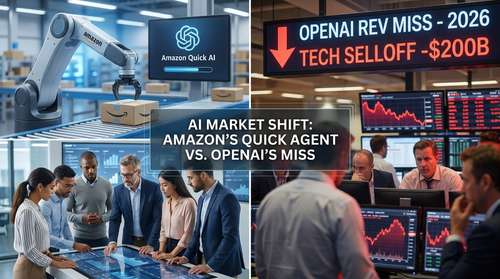
As Wall Street braces for what analysts are already calling the defining tech sector reckoning of the year, a striking divergence is unfolding across the industry. On Tuesday, April 28, 2026, AWS officially entered the autonomous enterprise software arena by launching the highly anticipated Amazon Quick AI agent. However, this major milestone for agentic AI technology was instantly overshadowed by a massive AI market selloff today. The catalyst? A bombshell report revealing an unexpected OpenAI revenue miss for 2026, sending shockwaves through the very infrastructure companies that power the artificial intelligence revolution.
The Dawn of Agentic AI Technology with Amazon Quick
While markets reel from shifting valuations, Amazon Web Services is fundamentally changing how knowledge workers interact with their applications. The Amazon Quick AI agent operates as a personalized desktop assistant designed to execute complex, cross-platform tasks natively. By leveraging the Model Context Protocol (MCP), Quick enables users to seamlessly connect disparate business tools—from Box and Canva to PagerDuty and GitHub—into a unified workflow interface.
This transition marks the true arrival of autonomous enterprise software. Rather than merely answering conversational queries, Quick utilizes a sophisticated Large Action Model (LAM) and native UI agents to perform intelligent web browser automation. A business user can now ask the system to pull incident logs, synthesize them into a visual presentation, and update a CRM dashboard without switching tabs. By natively adapting to real-time UI layout changes and bypassing the need for manual stitching between platforms, Amazon is positioning Quick as the definitive answer to enterprise automation at scale.
The ecosystem is expanding rapidly alongside the launch. Announcements at SUSECON 2026 revealed that the Amazon Quick AI agent can now invoke SUSE's MCP servers to autonomously troubleshoot Kubernetes clusters and Linux servers. Furthermore, native integration with ClickHouse Cloud means these agents can query billions of live data points in milliseconds, taking immediate action on anomalies before a human operator even opens a dashboard.
OpenAI Revenue Miss 2026 Triggers AI Market Selloff Today
Just as Amazon debuted its enterprise solution, the broader market narrative shifted violently. The Wall Street Journal reported that OpenAI fell substantially short of its internal 2026 sales and active user targets. The shortfall is largely attributed to aggressive enterprise market incursions from Anthropic's Claude and Alphabet's Gemini. The financial fallout was immediate, validating long-standing fears of an AI investment bubble.
The implications of this OpenAI revenue miss 2026 are rippling through the S&P 500 and the Nasdaq Composite. Partner stocks and computing infrastructure vendors took the brunt of the impact. Oracle, carrying heavy exposure due to a reported $300 billion data-center deal with the AI startup, plummeted 7% in premarket trading. CoreWeave and SoftBank also experienced steep declines, with the latter dropping nearly 10% in Tokyo. According to internal sources, OpenAI CFO Sarah Friar has expressed growing concerns that funding for future computing agreements could dry up if revenue growth fails to keep pace with astronomical infrastructure costs.
The Looming Capex Crisis
The timing is perilous for hyperscalers facing Big Tech earnings week. JPMorgan strategist Samik Chatterjee recently revised his data-center capital expenditure forecast, projecting a staggering 63% jump in 2026—amounting to an unprecedented $200 billion spending surge. Investors are aggressively questioning whether this mammoth infrastructure outlay will ever generate adequate returns. Tesla's recent capex-driven stock slide served as an early warning, but the AI market selloff today indicates a much broader structural reassessment by Wall Street.
Navigating the SaaS-Pocalypse Tech Trends
Industry insiders have dubbed this rapid market realignment the "SaaS-pocalypse." As legacy software-as-a-service providers face massive disruption, the pivot toward agentic AI technology has become a survival imperative. Corporate buyers no longer want passive tools; they demand active systems capable of multi-step reasoning and self-correction.
Amazon's strategic timing capitalizes precisely on these SaaS-pocalypse tech trends. By sitting squarely between low-code builders like Zapier and heavy machine learning stacks, Quick offers enterprises a way to build secure, scalable AI agents without requiring an army of specialized engineers. The focus is entirely on utility and cost reduction, a stark contrast to the exorbitant spending happening at the foundation model layer.
What the AI Investment Bubble Means for the Future
The events of April 2026 highlight a critical maturation phase for the industry. We are witnessing a clear bifurcation between the underlying compute infrastructure providers—who are currently being punished by an AI investment bubble mentality—and the practical application layer represented by autonomous enterprise software.
Companies providing raw compute power are finding themselves subjected to brutal market corrections when consumer adoption metrics falter. Meanwhile, platforms that integrate securely into daily corporate life to tangibly reduce operating costs are gaining undeniable traction. The launch of the Amazon Quick AI agent points the way forward: practical, action-oriented intelligence that executes real work. As the dust settles on this historic tech sector correction, the true winners will be the organizations that successfully cross the chasm from experimental AI to operational automation.