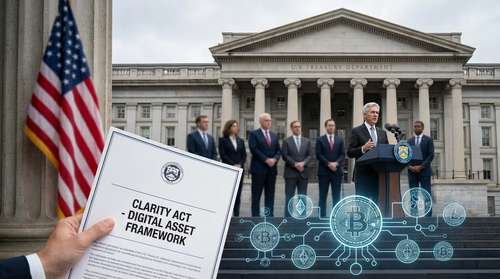
The future of the American cryptocurrency industry hangs in the balance this April as federal authorities escalate pressure on lawmakers. In a high-priority call to action, Treasury Secretary Scott Bessent and leading financial regulators have urged Congress to immediately pass the Clarity Act crypto bill. The landmark legislation aims to definitively formalize how tokenized securities and decentralized exchanges are governed under federal law. If approved, it would mark a monumental shift for U.S. crypto regulation 2026, solidifying the United States as the global hub for digital finance while preventing innovative developers from fleeing overseas.
Securing U.S. Leadership: The Push from Scott Bessent Treasury
The latest wave of momentum for the Clarity Act crypto bill began with an aggressive public campaign led by the Treasury Department. On April 8, a Wall Street Journal op-ed authored by the Treasury Secretary stressed the necessity of clear jurisdictional boundaries for digital assets. This message was quickly amplified across social media as the Scott Bessent Treasury administration emphasized the sheer scale of the global crypto ecosystem, which has recently fluctuated between $2 trillion and $3 trillion in market capitalization.
Bessent argued that without durable rules, the United States risks losing its competitive edge to jurisdictions with clearer guidelines, such as Singapore and Abu Dhabi. For policymakers, the ultimate goal is to onshore blockchain innovation before regulatory ambiguity further pushes talented builders abroad. As Bessent poignantly noted, keeping financial infrastructure, job creation, and tax revenues stateside depends heavily on providing safe harbors and reliable compliance pathways for developers.
Project Crypto and the Tokenized Securities Framework
The structural gap between the Securities and Exchange Commission (SEC) and the Commodity Futures Trading Commission (CFTC) has long been a pain point for the industry. The CLARITY Act intends to resolve this friction by mapping out a comprehensive tokenized securities framework that formally distinguishes digital commodities from traditional securities.
If enacted, the legislation will introduce several pivotal market changes:
- Clear Asset Definitions: Establishing precise statutory definitions that clarify when a digital asset transitions from a security to a commodity.
- Exchange Registration: Providing tailored registration processes for decentralized exchanges and intermediaries that reflect the reality of blockchain technology.
- Enhanced Consumer Protections: Integrating robust custody safeguards, disclosure requirements, and modern anti-money laundering provisions.
- Synergy with the Genius Act: Extending the dollar-backed stablecoin rules established by the 2025 Genius Act to support broader decentralized finance ecosystems.
Adding fuel to the legislative fire, SEC Chair Paul Atkins confirmed on April 9 that his agency is actively preparing for the bill's impending passage. Atkins announced the mobilization of 'Project Crypto,' an internal initiative designed to ensure that both the SEC and CFTC are fully equipped to implement the legislation the moment it is signed into law. According to Atkins, passing this comprehensive digital asset legislation will future-proof the industry against regulatory overreach while offering clear operating guidelines.
Senate Banking Committee News: Overcoming Stablecoin Disputes
Despite heavy bipartisan support that saw the bill clear the House of Representatives by a sweeping 294-134 vote in July 2025, the framework hit a significant roadblock. The latest Senate Banking Committee news reveals that the hold-up primarily stems from conflicts over stablecoin yield provisions.
Traditional banks have expressed deep concern that allowing stablecoin issuers to pay interest directly to users could drain deposits and restrict traditional bank lending capacities. However, this narrative has faced strong pushback from tech advocates and federal officials alike.
The White House Stance on Traditional Banking Fears
Recent data from the White House Council of Economic Advisers challenged the banking sector's claims, estimating that banning stablecoin yields would lift total U.S. bank lending by a mere 0.02% of the $12 trillion market. Furthermore, former White House Crypto Czar David Sacks publicly endorsed Bessent's urgency, noting that Congress has spent years debating how to structure this market and must finally act. President Trump has also reportedly criticized banks for leveraging the yield dispute to obstruct broader digital asset progress.
The Final Window for Legislative Action
Time is running incredibly short. With the 2026 midterm elections fast approaching, a shift in congressional control could indefinitely stall any major structural overhaul. While Polymarket odds recently dipped below 60% regarding the bill's passage this year, displaying investor uncertainty, the unified front from federal regulators provides renewed optimism.
Supporters anticipate a critical markup hearing in late April led by Chairman Tim Scott, potentially paving the way for a Senate floor vote in early May. If Congress can bridge the gap on remaining disputes, they will successfully lay the groundwork for long-term domestic innovation. Passing the Clarity Act crypto bill wouldn't just establish a clear rulebook; it would definitively signal that the United States intends to own the future of digital finance.