
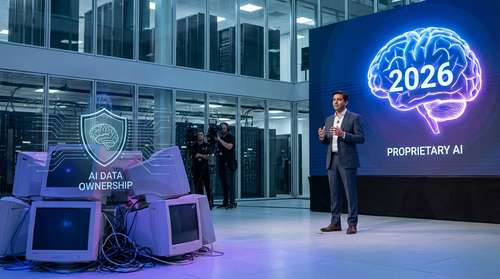
In a declaration that has sent shockwaves through the technology sector this Monday morning, InMobi CEO Naveen Tewari has effectively called time on the era of software dominance. Speaking at the India AI Impact Summit over the weekend, Tewari articulated a reality that has been crystallizing throughout early 2026: the traditional software moat is dry, and the new seat of power lies strictly with proprietary AI models trained on exclusive, high-value data.
For decades, the tech industry operated on the maxim that "software is eating the world." But as we navigate the first quarter of 2026, it appears that AI has eaten the software. The industry is witnessing a rapid reorganization where the value of coding logic—once the primary differentiator for SaaS companies—has collapsed near zero. In its place, a new hierarchy has emerged, prioritizing companies that control unique datasets capable of training specialized, vertical AI agents.
The Commoditization of Frontier Models
The core of Tewari’s argument rests on the rapid commoditization of what were once considered exclusive "frontier models." By 2026, foundational models from giants like Google, OpenAI, and Anthropic have effectively become digital utilities—powerful, necessary, but accessible to everyone and differentiable by almost no one.
"The power is moving into the proprietary models that you are basically training using proprietary data," Tewari stated during his keynote. "So even all the frontier models are all commoditised. The value is in the models which have proprietary data."
This shift represents a fundamental disruption for the tech industry. For years, startups and enterprises built their valuations on proprietary codebases. Today, with AI capable of generating complex code in seconds, that intellectual property is no longer a defensible barrier. The new competitive advantage isn't the engine (the AI model architecture); it's the fuel (the proprietary data) that makes the engine run in a way no competitor can replicate.
Rise of Vertical AI and Specialized Models
As the general purpose model market saturates, the future of software in 2026 is being defined by "Vertical AI"—highly specialized models designed for specific industries, regions, or tasks. This transition moves beyond the broad capabilities of a chatbot to the precise, outcome-driven performance of industrial-grade AI.
Tewari emphasized that while the West may have dominated the internet era and the initial build-out of AI infrastructure, the application layer—specifically specialized AI models—is a level playing field. Companies that have spent the last decade accumulating deep, messy, and exclusive records of consumer behavior, medical history, or supply chain logistics are now holding the winning hand.
For InMobi, this strategy is manifest in their pivot toward "agentic commerce." By leveraging data from over 2 billion users across the Glance lock-screen ecosystem, the company is training models that don't just recommend products but understand user intent deeply enough to act as autonomous agents. This isn't just better software; it's a proprietary intelligence layer that a competitor cannot clone simply by hiring better engineers.
The $3 Trillion Agentic Commerce Opportunity
One of the most striking predictions to come out of the summit was the potential economic impact of this shift. Tewari projected that AI agents and agentic commerce could unlock a staggering $3 trillion in value for the Indian economy alone by 2047. This figure underscores the scale of the disruption: we are moving from a passive internet of "search and retrieval" to an active internet of "anticipation and execution."
In this agentic future, the model acts on behalf of the user. It doesn't present ten links to blue shirts; it understands your style, your budget, and the upcoming weather, then procures the correct item. The technology required to do this relies entirely on AI data ownership. A general model knows what a shirt is; only a proprietary model trained on user history knows which shirt you will actually buy.
India's Strategic Pivot in 2026
The "death of software" narrative also offers a strategic reset for global tech hubs, particularly India. For years, the region was viewed as the back office of the world's software giants. However, the 2026 landscape rewards scale of data and speed of application over foundational R&D.
"Now, it's a level playing field," Tewari noted, highlighting that India's massive digital population provides the ideal testing ground for fine-tuning these proprietary models. With startups like Sarvam AI also unveiling competitive frontier models at the same summit, it is clear that the region is moving from maintaining legacy code to defining the tech industry disruption of the late 2020s.
The New Rules for Tech Valuations
For investors and founders reading this in 2026, the message is stark. The metrics of success have changed. Lines of code, feature velocity, and traditional SaaS metrics are losing relevance. The new gold standard metrics are:
- Data Exclusivity: Do you own data no one else can access?
- Model Fine-tuning: How effectively does your model learn from that data?
- Agentic Capability: Can your AI take independent action to solve user problems?
As the dust settles on the India AI Impact Summit, the industry is left with a clear directive: Stop building software. Start building intelligence.