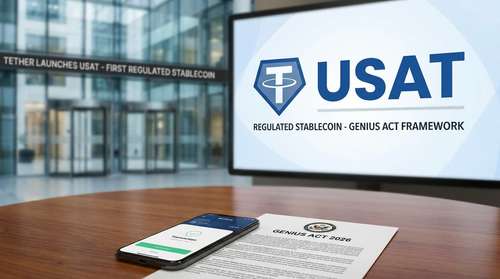
In a historic move that reshapes the American digital asset landscape, Tether has officially entered the U.S. market with the launch of USAT, its first federally regulated stablecoin. Announced on Tuesday, January 27, 2026, USAT is designed to operate strictly within the framework of the newly enacted GENIUS Act. Issued in partnership with Anchorage Digital Bank, the launch marks the end of Tether's long-standing exclusion from the U.S. financial system and positions the crypto giant to challenge Circle’s USDC for domestic dominance.
Breaking Down the Launch of USAT
Tether’s entry into the regulated U.S. market is a strategic pivot for the company, known globally for its flagship USDT token. Unlike USDT, which continues to serve international markets with a market cap exceeding $186 billion, USAT is tailored specifically for American institutions and consumers. The new stablecoin is issued by Anchorage Digital, the first crypto-native firm to receive a federal national trust bank charter from the Office of the Comptroller of the Currency (OCC).
By partnering with a federally chartered bank, Tether ensures that USAT meets the rigorous standards set by the Guiding and Establishing National Innovation for U.S. Stablecoins (GENIUS) Act, which was signed into law by President Trump in July 2025. This legislative framework mandates that domestic stablecoin issuers maintain 1:1 reserve backing with high-quality liquid assets and submit to monthly public audits—requirements that USAT fulfills from day one.
The GENIUS Act 2026: A New Era for Crypto
The launch of USAT is the most significant development since the passage of the GENIUS Act. The legislation, which aimed to clarify the regulatory haze hanging over the crypto industry, established a dual-track system: one for permitted domestic issuers like Anchorage Digital, and another for foreign issuers seeking reciprocity. The act’s stringent requirements for anti-money laundering (AML) and reserve transparency were designed to integrate stablecoins into the core U.S. financial infrastructure.
Bo Hines, the newly appointed CEO of Tether USAT and former Executive Director of the White House Crypto Council, emphasized the token's compliance-first approach. "USAT is not just a digital dollar; it is a declaration that stablecoins belong inside the U.S. banking system," Hines stated. "We are providing American institutions with the liquidity of Tether and the safety of a federally regulated bank."
Anchorage Digital and Cantor Fitzgerald: The Infrastructure
To build trust with U.S. regulators and Wall Street alike, Tether has assembled a formidable infrastructure team. While Anchorage Digital handles the issuance and compliance, ensuring the token is a "bank-issued digital dollar," financial services powerhouse Cantor Fitzgerald serves as the reserve custodian and primary dealer. Cantor already manages the vast majority of the U.S. Treasury bills backing Tether’s global USDT, and their involvement signals institutional-grade reliability for USAT.
USAT vs. USDC: The Battle for America
The introduction of USAT poses a direct threat to Circle’s USDC, which has long enjoyed a monopoly as the "compliant" alternative in the United States. With the GENIUS Act leveling the playing field, Tether is betting that its deep liquidity and brand recognition will translate into rapid domestic market share. While USAT launched with a modest initial cap of $20 million, analysts predict aggressive growth as major exchanges like Kraken, Coinbase, and Crypto.com integrate the token.
Market Reaction and Future Outlook
The crypto markets have reacted positively to the news, with industry leaders viewing this as a sign of maturity for the asset class. Jeremy Allaire, CEO of rival Circle, recently noted at Davos that stablecoin adoption could grow by 40% annually, a pie that Tether is now hungry to slice. By bifurcating its product line—keeping USDT for global, offshore commerce and USAT for compliant, onshore settlement—Tether effectively protects its global empire while opening a new front in the U.S.
As 2026 unfolds, the success of USAT will likely serve as a litmus test for the GENIUS Act itself. If Tether can successfully transition from an offshore disruptor to a regulated insider, it could pave the way for a wave of institutional adoption, finally bridging the gap between Wall Street and the blockchain.