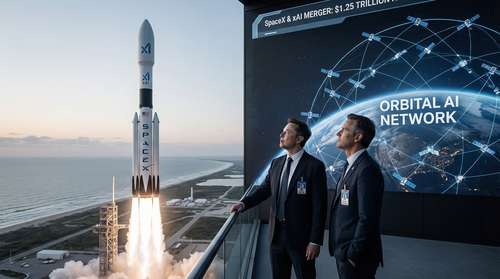
In a move that fundamentally reshapes the technology landscape, SpaceX has officially acquired xAI in a historic merger valued at approximately $1.25 trillion. The deal, announced late Monday, consolidates Elon Musk’s aerospace dominance with his rapidly growing artificial intelligence venture, creating a vertically integrated giant capable of deploying the world’s first space-based AI infrastructure.
The combined entity, which brings together the Starlink satellite network, the Starship launch system, and the Grok AI model family, aims to solve the critical energy bottlenecks facing terrestrial artificial intelligence. By launching high-density data centers into orbit, the new company plans to leverage limitless solar energy and vacuum cooling to train the next generation of superintelligence, a strategy Musk has described as creating a "sentient sun to understand the universe."
The $1 Trillion Consolidation: Deal Mechanics & Structure
According to internal memos and regulatory filings released this week, the all-stock transaction prices the combined shares at roughly $527 each. This massive valuation reflects not just the current revenue of SpaceX—which generated an estimated $8 billion in profit last year—but the explosive potential of a unified space-AI economy. The merger also pulls the social media platform X (formerly Twitter) under the SpaceX banner, following xAI’s acquisition of the platform in March 2025.
Financial analysts view the move as a strategic stabilization for xAI, which had been burning approximately $1 billion monthly to compete with OpenAI and Google. By merging with SpaceX, which boasts a robust cash flow from government contracts and Starlink subscriptions, the AI division gains immediate access to the capital and launch capacity required for its ambitious orbital roadmap. "This isn't just a merger; it's an ecosystem play," said one senior tech analyst. "Musk is betting that the only way to scale compute beyond Earth's power grid is to leave the planet entirely."
Why Orbit? Solving the AI Energy Crisis
The primary driver behind this colossus is the physical limitation of Earth’s power grids. With terrestrial data centers consuming nearly 4% of global electricity—a figure projected to triple by 2030—tech giants are facing severe resistance from local governments and utility providers. The SpaceX xAI merger circumvents this by moving the hardware to Low Earth Orbit (LEO).
Unlimited Power and Passive Cooling
Space-based data centers offer two distinct advantages that terrestrial facilities cannot match: 24/7 access to unattenuated solar power and near-infinite radiative cooling. In the vacuum of space, operators can deploy massive solar arrays—potentially kilometers wide—without land-use permits or weather interruptions. The merged company plans to utilize Starship, SpaceX’s mega-rocket, to loft these pre-fabricated "compute modules" at a fraction of the cost of traditional launches.
Engineers estimate that an orbital cluster could achieve energy efficiencies five times greater than ground-based counterparts. "On Earth, half your energy budget goes to cooling," noted a lead engineer in the filed whitepaper. "In orbit, you simply radiate heat away into the void, allowing nearly 100% of power to flow directly into the GPUs."
Grok 4 and the 'Orbital Brain'
The immediate beneficiary of this infrastructure will be Grok, xAI’s flagship large language model. The upcoming Grok 4 iteration is rumored to require training clusters so large they would destabilize regional power grids on Earth. By shifting this workload to a constellation of orbital satellites, xAI can train larger models faster and cheaper than rivals constrained by terrestrial energy prices.
This "orbital brain" will also integrate directly with the Starlink network, potentially offering low-latency AI inference directly to users anywhere on Earth. This creates a closed-loop system where data is collected, processed, and served entirely within the SpaceX ecosystem, bypassing traditional fiber backbones and third-party cloud providers.
Regulatory Hurdles and Market Reaction
While the technological vision is bold, the merger faces significant scrutiny. Critics argue that consolidating the world’s largest satellite operator with a leading AI developer and a major social media platform creates a dangerous monopoly on information infrastructure. Regulatory bodies in the EU and US are expected to review the deal closely, particularly concerning the dual use of orbital compute for military applications.
Despite these headwinds, the market has reacted with volatility but optimism. SpaceX shares (trading privately) surged on the news, while competitors in the cloud computing space saw slight dips. As the race for Artificial General Intelligence (AGI) accelerates, the SpaceX-xAI union signals that the final frontier for big tech may literally be the final frontier.