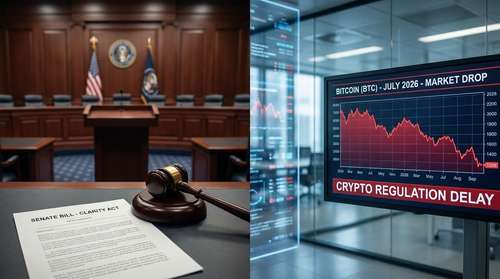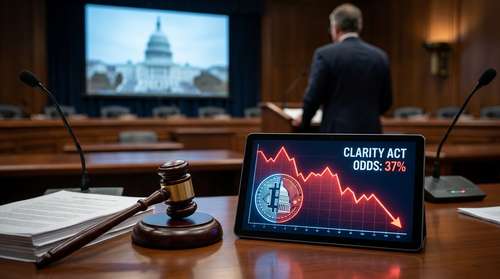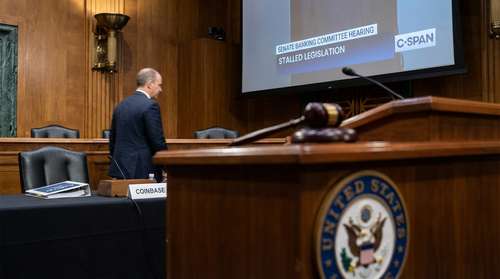
The U.S. Senate Banking Committee has officially stalled the markup of the landmark CLARITY Act (Digital Asset Market Clarity Act), plunging the future of US crypto regulation 2026 into uncertainty. The abrupt halt comes just days after Coinbase, the largest cryptocurrency exchange in the United States, publicly withdrew its support for the legislation. CEO Brian Armstrong cited new "poison pill" amendments favoring the banking lobby—specifically banning stablecoin yields and restricting tokenized equities—as the primary reason for the reversal.
CLARITY Act Delay Sparks Crisis in Washington
The CLARITY Act delay represents a massive setback for the digital asset industry, which had viewed the bill's passage through the House in July 2025 as a historic victory. Sponsored by Senate Banking Committee Chairman Tim Scott, the bill was intended to provide a comprehensive digital asset market structure, clarifying the jurisdiction between the SEC and CFTC.
However, the legislative process ground to a halt this week after negotiations collapsed. Sources close to the committee confirm that the inclusion of strict prohibitions on non-bank stablecoin issuers offering yield products caused a revolt among industry leaders. "No bill is better than an overly bad one," Armstrong stated during a heated exchange at the World Economic Forum in Davos earlier this week, signaling that Big Crypto is no longer willing to accept regulation at any cost.
The 'Anti-Innovation' Clauses: Tokenized Equities and Stablecoins
At the heart of the dispute are two critical provisions that Coinbase and other industry heavyweights view as existential threats. The first is a proposed ban on crypto exchanges offering yield on stablecoins, a feature Armstrong argues is essential for competing with traditional banks. The banking lobby has aggressively pushed for this clause, arguing that interest-bearing stablecoins amount to unregulated banking deposits.
The second contention involves tokenized equities regulations. While the SEC recently issued guidance clarifying the distinction between issuer-backed and third-party tokenized securities, the Senate bill's new language could effectively grant Wall Street a monopoly on issuing these assets. Coinbase, which has been seeking to expand into tokenized real-world assets (RWAs), views this as a direct attempt to stifle competition.
Senate Banking Committee Crypto Standoff
The tension within the Senate Banking Committee crypto negotiations highlights a widening rift between lawmakers and the industry they seek to regulate. While the Senate Agriculture Committee managed to advance its companion bill—the Digital Commodity Intermediaries Act—earlier this week, it cannot become law without the Banking Committee's component.
Senator Scott released a "bipartisan manager's amendment" on January 12 in an attempt to salvage the bill, but the concessions made to Democratic skeptics and banking lobbyists ultimately alienated the crypto coalition. With the 2026 midterms looming, the window for passing comprehensive Coinbase crypto legislation is rapidly closing. Political analysts now fear the bill could be dead on arrival if a compromise isn't reached before the February recess.
Brian Armstrong's Crypto Policy Gamble
Brian Armstrong's crypto policy strategy has shifted from diplomatic engagement to hardline negotiation. By withdrawing support for a bill that was largely seen as "better than nothing," Armstrong is betting that the industry's political capital is strong enough to force a rewrite.
In a recent interview, Armstrong dismissed claims of a rift with the White House, despite reports that administration officials were "furious" over the last-minute pullout. "We want clear rules, but we won't sign our own death warrant," a Coinbase spokesperson told reporters. The exchange's stance reflects a broader industry sentiment that the U.S. risks falling behind global competitors if it adopts a protectionist regulatory framework that favors incumbent financial institutions over technological innovators.