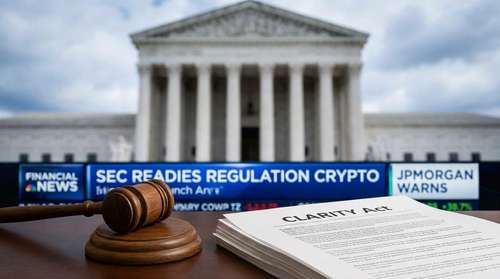
With a critical White House-imposed deadline looming just days away, the U.S. Senate is scrambling to finalize the CLARITY Act 2026, a landmark piece of legislation poised to redefine the American digital asset landscape. Following a weekend of intense high-level negotiations, optimism is surging that the long-stalled bill—formally the Digital Asset Market Clarity Act—will finally clear the Senate Banking Committee. Industry titans and regulators alike are signaling that the months-long legislative logjam is breaking, setting the stage for a vote that could end the era of regulatory ambiguity.
White House Sets March 1 Deadline to Break Senate Stalemate
The urgency in Washington has reached a fever pitch following reports that the White House Crypto Policy Council has set a firm March 1 deadline to resolve the remaining disputes blocking the bill. The primary sticking point has been a contentious debate over "stablecoin yield," a technical but vital issue that threatens to derail the broader market structure framework.
Recent days have seen a flurry of activity suggesting a compromise is near. Coinbase CEO Brian Armstrong publicly stated on Saturday that he sees a "viable path forward," a sentiment echoed by Ripple CEO Brad Garlinghouse, who yesterday pegged the bill's chances of passing by April at 90%. "The industry can no longer run on enforcement alone," Garlinghouse told reporters. "We are finally seeing the political will to get this done."
The GENIUS Act Legacy and the New Battleground
To understand the current tension, one must look back to the GENIUS Act, signed into law by President Trump in July 2025. That law successfully established reserve requirements for stablecoin issuers but left a critical loophole: while issuers were banned from paying interest to users, exchanges and intermediaries were not explicitly prohibited from passing on rewards.
Banking lobbyists have fiercely argued that allowing crypto exchanges to offer yield on stablecoin deposits creates an uneven playing field that threatens traditional bank deposits. The current Senate negotiations aim to close this gap in the CLARITY Act, with the White House brokering a deal that balances consumer protection with the crypto industry's need for competitive product offerings.
SEC Chair Paul Atkins Champions "Project Crypto"
Perhaps the most significant shift in the 2026 legislative landscape is the cooperative tone coming from the Securities and Exchange Commission. Speaking at ETHDenver just four days ago, SEC Chair Paul Atkins outlined a refreshing departure from the antagonistic "regulation by enforcement" tactics of his predecessor.
Atkins detailed "Project Crypto," a joint initiative with CFTC Chair Michael Selig designed to harmonize oversight before the CLARITY Act even hits the President's desk. "A clear framework for crypto assets is long overdue," Atkins told the audience. "We are moving toward a system where compliance is possible, practical, and protective."
This collaboration is central to the CLARITY Act, which seeks to draw a bright line between SEC vs CFTC jurisdiction. Under the proposed framework, digital assets that are sufficiently decentralized—a standard the bill aims to codify—would be treated as digital commodities under CFTC oversight, while the SEC would retain authority over digital asset securities.
Institutional Capital Waiting on the Sidelines
The passage of the CLARITY Act is widely viewed as the "final box to check" for massive institutional entry into the crypto market. While the 2025 approval of spot ETFs and the GENIUS Act provided initial confidence, the lack of a comprehensive market structure bill has kept trillions of dollars in conservative capital on the sidelines.
Market analysts predict that a successful Senate vote in March could trigger a "compliance boom," where traditional financial institutions launch deeper crypto integrations, secure in the knowledge that they are operating under a federally sanctioned digital assets regulatory framework. With the March 1 deadline approaching, all eyes are on the Senate Banking Committee to deliver the clarity the market has demanded for over a decade.