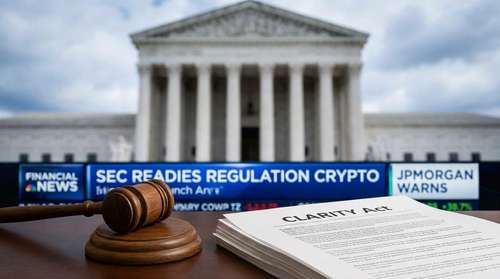

In a watershed moment for the integration of digital assets into the U.S. financial system, the Securities and Exchange Commission (SEC) has effectively slashed the capital "haircut" for qualifying stablecoins from a prohibitive 100% to just 2%. The move, detailed in a revised Broker-Dealer Financial Responsibility FAQ released by the Division of Trading and Markets on February 19, 2026, signals a decisive shift in how federal regulators view payment stablecoins. By allowing broker-dealers to treat these digital assets with the same capital efficiency as money market funds, the SEC is unlocking billions in liquidity and paving the way for massive institutional stablecoin adoption. This regulatory update, long sought by industry proponents, is a direct outcome of the framework established by the GENIUS Act and aligns with the agency's broader modernization efforts under SEC Project Crypto.
Breaking Down the 2% Stablecoin Haircut Rule
For years, registered broker-dealers faced a stark choice: avoid stablecoins entirely or accept a punitive 100% capital charge. Under the Net Capital Rule (Rule 15c3-1), firms must maintain liquid assets to protect customers. Previously, the SEC treated stablecoins as non-allowable assets, effectively valuing them at zero for capital purposes. This made holding digital dollars like USDC on a broker's balance sheet economically unviable.
The new guidance changes this calculus overnight. SEC staff confirmed they "would not object" if broker-dealers apply a mere 2% haircut to proprietary positions in "qualifying payment stablecoins." This adjustment puts compliant digital dollars on par with traditional instruments like Treasury bills and commercial paper. To qualify, a stablecoin must meet strict criteria:
- Reserve Backing: Must be backed 1:1 by cash or short-term U.S. government securities.
- Transparency: Issuers must provide monthly, independent attestations of reserves.
- Regulatory Status: Issuers must be state-regulated money transmitters or trust companies, or national trust banks.
This nuanced approach effectively filters out opaque offshore issuers while rewarding transparent, U.S.-domiciled players who have adhered to the rigorous standards of the GENIUS Act regulation.
Hester Peirce and the "Crypto Mom" Catalyst
SEC Commissioner Hester Peirce, affectionately known as "Crypto Mom," has been instrumental in driving this policy shift. In her accompanying statement titled "Cutting by Two Would Do," released alongside the FAQ, Peirce argued that the previous 100% deduction was "unnecessarily punitive" for assets that are functionally equivalent to the U.S. dollar. She emphasized that the new guidance is a pragmatic step toward regulatory reality.
"Stablecoins are the lifeblood of on-chain transactions," Peirce noted in her Hester Peirce crypto statement. "By aligning our capital rules with economic reality, we are enabling broker-dealers to safely engage with this technology rather than forcing it into the shadows." Her comments reflect a broader consensus building within the agency under Chair Paul Atkins, whose leadership has prioritized clarity over enforcement-heavy tactics. This move is widely seen as the first major deliverable of SEC Project Crypto, an internal initiative designed to modernize securities rules for the digital age.
The GENIUS Act Connection
The timing of this relief is no coincidence. It follows the implementation of the Guiding and Establishing National Innovation for U.S. Stablecoins Act (GENIUS Act), signed into law in July 2025. The legislation created a federal floor for stablecoin issuance, giving regulators the comfort needed to lower capital barriers. The SEC's new FAQ explicitly references the definitions found in the GENIUS Act, creating a cohesive regulatory fabric that links legislative intent with agency enforcement.
Impact on Institutional Stablecoin Adoption
The implications for institutional stablecoin adoption are profound. With the capital penalty removed, major Wall Street firms can now hold stablecoins directly to facilitate 24/7 settlement, instant margin calls, and cross-border liquidity management. Previously, a firm holding $100 million in USDC would need $100 million in regulatory capital to back it. Now, that requirement drops to just $2 million.
This capital efficiency is expected to trigger a surge in digital asset liquidity. Market makers can now inventory stablecoins without blowing up their balance sheets, leading to tighter spreads and deeper markets for tokenized securities. "This is the plumbing upgrade we've been waiting for," said a senior executive at a major prime brokerage. "It transforms stablecoins from a niche crypto tool into a legitimate settlement instrument for traditional finance."
Broker-Dealer Capital Rules 2026: What's Next?
While the 2% haircut is a massive victory, it is technically "staff guidance" rather than a formal rule change. However, in the world of securities regulation, such FAQs often serve as de facto law until permanent rules are written. The industry is now watching closely to see if the Commodity Futures Trading Commission (CFTC) will follow suit for futures commission merchants (FCMs).
As we move further into 2026, the convergence of traditional finance (TradFi) and decentralized finance (DeFi) is accelerating. The broker-dealer capital rules 2026 update is more than just a math adjustment; it is a signal that the U.S. is finally ready to compete in the digital economy. For investors and firms alike, the message is clear: the barriers to entry are falling, and the digital dollar is open for business.