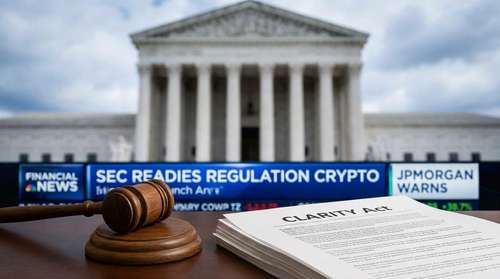

In a landmark announcement at ETHDenver regarding the SEC Project Crypto roadmap, Chairman Paul S. Atkins and Commissioner Hester Peirce have officially unveiled a comprehensive regulatory strategy that promises to reshape the United States' digital asset landscape. Speaking to a packed audience on February 19, 2026, Atkins introduced a revolutionary "super-app" licensing model and a clear path for token decentralization, marking a decisive end to the era of regulation by enforcement. This new agenda, designed to implement the pending CLARITY Act 2026 and the recently enacted GENIUS Act, positions the U.S. to reclaim its status as the global epicenter of crypto innovation.
The "Project Crypto" Roadmap: A New Era of Regulatory Clarity
The centerpiece of the announcement is the full deployment of "Project Crypto," an agency-wide initiative led by Commissioner Hester Peirce. For the first time, the SEC has provided a concrete "Token Taxonomy" that categorizes digital assets based on economic reality rather than rigid legal interpretations. This roadmap explicitly defines how tokens can transition from being classified as securities to becoming "digital commodities" or "network tokens" as their underlying protocols decentralize.
"We are moving from a posture of fear to a framework of functionality," Atkins declared. Under this new regime, projects will have a clear, step-by-step guide to prove decentralization, effectively graduating from SEC oversight to a disclosure-based model. This move directly addresses the industry's long-standing demand for a viable path to compliance without stifling technological development.
Revolutionary "Super-App" Licenses for Hybrid Trading
Perhaps the most disruptive element of the Paul Atkins SEC crypto agenda is the introduction of the "super-app" license. Historically, financial platforms were forced to segregate crypto trading, traditional securities, and banking services, creating a fragmented user experience. The new crypto super-app license will allow unified platforms to offer a seamless blend of services under a single federal regulatory umbrella.
Key features of the Super-App License include:
- Unified Trading: Users can trade Bitcoin, tokenized Apple stock, and ETFs side-by-side in one interface.
- Integrated Custody: A single qualified custodian framework for both digital and traditional assets.
- Staking Services: Clear guidelines for offering staking rewards without triggering unregistered securities violations.
This "all-in-one" approach is expected to trigger a wave of mergers and acquisitions as traditional broker-dealers and crypto-native exchanges race to build the first federally licensed financial super-apps.
Innovation Exemptions and the GENIUS Act Implementation
Commissioner Hester Peirce's crypto innovation task force has also introduced a "Safe Harbor 2.0" in the form of an official Innovation Exemption. This pilot program allows startups to launch tokenized securities on decentralized platforms with limited volume caps, enabling them to test market viability before pursuing full registration. This "sandbox" environment is designed to foster the next generation of blockchain technology within U.S. borders.
Simultaneously, the SEC is aligning its enforcement priorities with the GENIUS Act implementation (Guiding and Establishing National Innovation for U.S. Stablecoins Act). In a significant regulatory concession, the SEC Division of Trading and Markets updated its FAQs this week, allowing broker-dealers to apply a mere 2% "haircut" (capital reserve requirement) on stablecoin holdings, down from the prohibitive 100% standard. This seemingly technical change is a massive win for liquidity, effectively treating approved stablecoins as cash equivalents for institutional traders.
Future-Proofing via the CLARITY Act
While the SEC's roadmap provides immediate relief, Chairman Atkins emphasized that statutory permanence is the ultimate goal. He explicitly urged the Senate to pass the CLARITY Act 2026 news (Cryptocurrency Laws and Regulations for Innovation, Technology, and Yield Act), which would codify these regulatory boundaries into federal law. "Regulation by enforcement is over," Atkins stated. "But to ensure this new dawn lasts, we need the CLARITY Act to future-proof our rulebook against political winds."
The roadmap has been met with cautious optimism from industry leaders, who see it as the most significant step toward regulatory normalization in a decade. By harmonizing the SEC's investor protection mandate with the reality of decentralized networks, Project Crypto aims to unlock trillions of dollars in capital currently sitting on the sidelines.