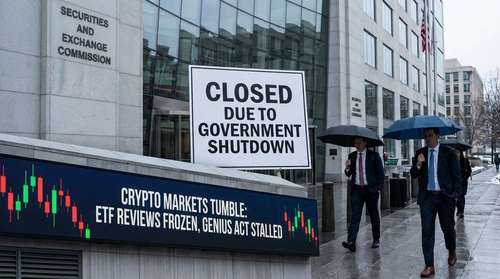
February 2, 2026 – The U.S. crypto market faces a renewed crisis this morning as the federal government enters its third day of a partial shutdown. With Congress failing to pass a stopgap spending bill over the weekend, the SEC crypto shutdown 2026 scenario has become a harsh reality. The Securities and Exchange Commission (SEC) has transitioned to "emergency-only" staffing, effectively freezing the review process for pending spot ETF applications and stalling the critical implementation of the GENIUS Act. As regulatory machinery grinds to a halt, the crypto market has reacted swiftly, with Bitcoin testing support levels near $78,000 and altcoins suffering double-digit losses.
SEC Regulatory Freeze: "Emergency-Only" Mode
As of Saturday, January 31, the SEC officially activated its shutdown contingency plan. Under the leadership of Chairman Paul Atkins, the agency has furloughed over 90% of its workforce, retaining only a skeletal staff to handle situations involving "imminent threats to property or human safety." For the digital asset industry, this constitutes a total SEC regulatory freeze.
While the EDGAR filing system remains technically operational for automated submissions, there is no one behind the desk to review them. The Division of Trading and Markets and the Division of Investment Management—the key bodies responsible for approving new financial products—have ceased non-essential operations. This administrative paralysis means that any dialogue between issuers and regulators has effectively stopped, leaving the industry in a state of suspended animation.
Spot ETF Approval Delays: Solana and Litecoin on Hold
The most immediate casualty of the shutdown is the pipeline of crypto exchange-traded funds. Analysts confirm that the government shutdown impact on crypto is most acute for the 16 pending spot ETF applications currently sitting on the SEC's docket. Highly anticipated filings for Solana (SOL) and Litecoin (LTC) spot ETFs, which were rumored to be nearing approval windows in Q1 2026, are now indefinitely stalled.
Industry insiders warn that these spot ETF approval delays could extend well beyond the duration of the shutdown itself. "Every day the government is closed adds a week to the backlog," noted a senior ETF analyst. "The staff isn't just pausing; they are losing the momentum built up over the last few months of negotiations." With the "approval clock" effectively paused, issuers are bracing for a timeline shift that could push potential launches into late spring or summer 2026.
The GENIUS Act Implementation Stalled
Beyond ETFs, the shutdown has thrown a wrench into the machinery of statutory compliance. The Guiding and Establishing National Innovation for U.S. Stablecoins Act, known as the GENIUS Act, was signed into law in July 2025 to provide a federal framework for stablecoin issuers. However, the complex rulemaking process required to operationalize the law is now in jeopardy.
GENIUS Act implementation requires coordination between the SEC, the Treasury, and the CFTC to finalize rules regarding reserve audits and algorithmic restrictions. With all three agencies operating at diminished capacity, the deadline for final guidance—originally expected next month—will likely be missed. This delay creates a dangerous regulatory vacuum, leaving issuers uncertain about compliance standards for the fiscal year.
Crypto Market Crash February 2026: The "Data Vacuum"
The financial fallout was instantaneous. Fearing a prolonged stalemate, the crypto market crash February 2026 saw over $1.68 billion in leveraged positions liquidated within 48 hours. Bitcoin (BTC) tumbled from $85,000 to lows of roughly $78,000, while Ethereum (ETH) and Solana (SOL) posted sharper declines.
Compounding the fear is what economists are calling a "Data Vacuum." The shutdown has suspended the release of critical economic reports, including Non-Farm Payrolls and CPI inflation data. Without these macro signals, institutional investors are flying blind, leading to a massive risk-off rotation. "The market hates uncertainty," explains a macro strategist. "When you combine a regulatory blackout with a lack of economic data, the default move is to sell risk assets."
What’s Next for U.S. Crypto Regulation News?
All eyes are now on Capitol Hill, where the House is expected to reconvene later this week to attempt another vote. However, the political gridlock surrounding the DHS funding bill suggests this shutdown could drag on. For now, U.S. crypto regulation news will remain dominated by delays and uncertainty. Investors are advised to prepare for continued volatility as the industry navigates this period of government paralysis.