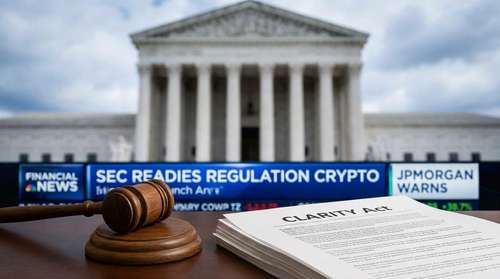
In a watershed moment for the digital asset industry, Securities and Exchange Commission (SEC) Chair Paul Atkins officially confirmed the rollout of the long-awaited innovation exemptions this week, targeting a full launch later in Q1 2026. Speaking to industry leaders and reporters on Thursday, Atkins signaled the definitive end of the "regulation by enforcement" era, unveiling a framework designed to integrate tokenized stocks and bonds into the heart of America's capital markets. This strategic pivot aims to cement the United States as the undisputed global leader in digital finance, offering a clear compliance runway for blockchain firms that have long operated in regulatory limbo.
The End of 'Regulation by Enforcement'
For years, the crypto industry has navigated a minefield of Wells notices and lawsuits. Chair Atkins' announcement marks a decisive turn away from these adversarial tactics toward a collaborative regulatory model. The new innovation exemption SEC framework establishes a two-year "safe harbor" period, allowing digital asset platforms to register with the agency without facing immediate retrospective enforcement actions.
"We must stop treating innovation like a threat and start treating it as a catalyst for economic renewal," Atkins stated during his address. Under this new regime, compliant firms can test novel market structures—such as 24/7 trading and atomic settlement—while retaining oversight. This move is widely seen as a direct response to the "brain drain" of crypto talent to offshore jurisdictions, a trend the Atkins administration has vowed to reverse.
Defining the 'Compliance Runway'
The exemptions are not a free pass but a structured pathway. Companies participating in the program must adhere to strict transparency standards, including real-time on-chain proof of reserves and robust customer disclosure requirements. In exchange, they are granted relief from certain legacy securities rules that were written for the paper-based markets of the 1930s, effectively modernizing the US crypto regulation 2026 landscape.
Unlocking Tokenized Stocks and Bonds
Perhaps the most transformative aspect of the new policy is its embrace of real-world asset (RWA) tokenization. The SEC crypto policy shift explicitly opens the door for regulated broker-dealers to offer tokenized stocks and bonds. This development aligns with the successful pilot programs recently conducted by the Depository Trust & Clearing Corporation (DTCC), which demonstrated the efficiency of blockchain-based settlement.
"The future of our public markets is on-chain," Atkins remarked, highlighting how tokenization can democratize access to financial instruments. By allowing equities and debt securities to be issued and traded on permissioned blockchains, the SEC aims to reduce settlement times from T+1 to near-instantaneous, slashing counterparty risk and freeing up billions in trapped capital.
Institutional Crypto Adoption Poised to Surge
Wall Street has been watching from the sidelines, waiting for exactly this kind of regulatory clarity. With the crypto compliance framework now coming into focus, major financial institutions are expected to accelerate their entry into the space. Analysts predict a wave of institutional crypto adoption as banks and asset managers leverage these exemptions to launch proprietary digital asset platforms and tokenized funds.
A recent report from TD Cowen, released alongside the SEC's announcement, characterizes this period as a "golden window" for policy progress. The firm notes that the convergence of political will and regulatory alignment has created the most favorable environment for crypto in U.S. history. Major players like BlackRock and Fidelity, who have already dipped their toes in with ETFs, are now positioned to dive deeper into on-chain infrastructure.
A New Era for Global Competitiveness
The stakes extend far beyond the crypto markets. Chair Atkins framed the innovation exemptions as a matter of national economic security. By providing a viable path for SEC Paul Atkins crypto reforms, the U.S. is reclaiming its mantle as the standard-setter for global finance. The move effectively counters the regulatory advances made by the EU's MiCA framework and similar regimes in Asia.
As the Q1 2026 rollout begins, the industry will be watching closely to see how the application process unfolds. While questions remain about the specific eligibility criteria for decentralized finance (DeFi) protocols, the message from Washington is unambiguous: the United States is open for digital business.