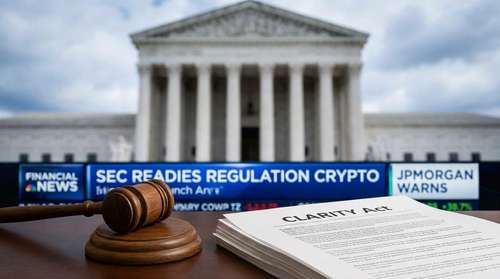

In a landmark move to end years of regulatory fragmentation, the U.S. Securities and Exchange Commission (SEC) and the Commodity Futures Trading Commission (CFTC) officially relaunched "Project Crypto" on January 29, 2026. This joint initiative, announced by SEC Chair Paul Atkins and newly confirmed CFTC Chair Michael S. Selig, marks a decisive pivot toward harmonized federal oversight of the digital asset industry. By establishing a unified "digital asset taxonomy" and formalizing interagency cooperation through a new memorandum of understanding, the regulators aim to provide the legal certainty necessary for tokenized real-world assets and perpetual futures to thrive on American soil.
Ending the Jurisdictional Turf War
For over a decade, the U.S. crypto market has been caught in a tug-of-war between the SEC and CFTC, with market participants often unsure which agency held jurisdiction over their activities. Project Crypto seeks to dismantle these silos. Speaking at a joint event at CFTC headquarters, Chairs Atkins and Selig outlined a "minimum effective dose" approach to regulation, prioritizing clarity over punitive enforcement.
The core of this initiative is a new memorandum of understanding (MoU) that commits both agencies to shared market surveillance and joint rulemaking. "We are moving from a posture of competition to one of coordination," Chair Selig stated, signaling an end to the "regulation by enforcement" era that characterized previous administrations. This harmonization is expected to streamline compliance for dual-registrants and eliminate duplicative reporting requirements that have historically burdened U.S. crypto firms.
A New Digital Asset Taxonomy
One of the most significant developments from the relaunch is the introduction of a clear, function-based taxonomy for digital assets. Moving away from broad generalizations, Chair Atkins proposed a four-category framework designed to reflect the "economic reality" of different tokens:
- Digital Commodities: Assets tied to decentralized protocols where value is not derived from managerial promises (e.g., established cryptocurrencies like Bitcoin).
- Digital Collectibles: Tokens designed primarily for collection rather than investment, covering the vast majority of the NFT market.
- Digital Tools: Functional tokens that provide specific utility, such as access rights, identity verification, or platform membership.
- Tokenized Securities: Financial instruments that meet the traditional definition of a security but are recorded on a blockchain.
This nuanced framework aims to resolve the "security vs. commodity" debate that has plagued the industry, allowing issuers to self-classify with greater confidence under clear regulatory guidance.
Green Light for Tokenization and Prediction Markets
The relaunch of Project Crypto has already yielded immediate regulatory shifts. On January 28, just a day prior to the joint announcement, the SEC issued comprehensive guidance on tokenized securities. The guidance clarifies that recording ownership on a blockchain does not alter an asset's fundamental legal status, effectively greenlighting the use of distributed ledger technology (DLT) for traditional financial instruments like stocks and bonds.
Simultaneously, the CFTC has made a major reversal regarding prediction markets. Chair Selig announced the withdrawal of a controversial 2024 proposal that sought to ban political and sports-related event contracts. Instead, the agency will move to regulate platforms like Kalshi and Polymarket under a new, permissive framework, recognizing them as valid hedging tools rather than mere gambling venues. This shift is expected to unlock billions in liquidity for onshore event contracts.
The Legislative Context: Building on the GENIUS Act
Project Crypto does not operate in a vacuum; it builds upon the legislative foundation laid by the GENIUS Act of 2025. That law, signed last year, established a federal regulatory system for stablecoins, requiring 100% reserve backing and creating a clear pathway for banks and non-banks to issue payment stablecoins. With the stablecoin question largely settled by Congress, the SEC and CFTC are now free to focus on the more complex market structure issues involving trading platforms and exchanges.
Industry Reaction and Market Outlook
The industry's response has been cautiously optimistic. Legal experts at major firms have hailed the move as the "democratization of digital assets," predicting that regulatory clarity will finally allow institutional capital to enter the market at scale. However, the transition hasn't been without short-term volatility. Markets experienced a "liquidity squeeze" and ETF outflows immediately following the announcement, as traders adjusted positions in anticipation of new compliance standards.
despite the short-term friction, the long-term outlook remains bullish. By aligning their playbooks, the SEC and CFTC are effectively rolling out a welcome mat for institutional innovation, aiming to cement the United States as the undisputed global capital for the digital asset economy in 2026 and beyond.