
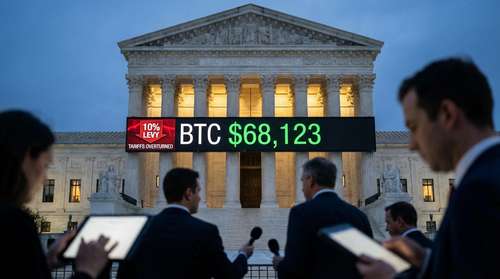
In a stunning blow to the administration's economic agenda, the Supreme Court has struck down President Trump's controversial "Liberation Day" tariff regime, ruling 6-3 that the executive branch overstepped its authority under the International Emergency Economic Powers Act (IEEPA). The decision, handed down late Friday, initially sent shockwaves through global markets, causing Bitcoin to dip sharply before staging a remarkable recovery. As traders digested the news, Bitcoin price rebound momentum kicked in, pushing the asset toward $68,000. However, the relief was short-lived. In a defiant counter-move, President Trump immediately signed a new executive order imposing a blanket Trump 10% global tariff using Section 122 of the Trade Act of 1974, ensuring the trade war continues unabated.
Supreme Court Tariff Ruling 2026: The End of IEEPA Overreach
The landmark Supreme Court tariff ruling 2026 centers on the interpretation of the IEEPA, a 1977 law intended for national emergencies. The Court held that while the President has broad powers to regulate economic transactions during a crisis, this authority does not explicitly extend to imposing sweeping new taxes on imports. Chief Justice Roberts, writing for the majority, emphasized that the power to tax lies with Congress, not the Oval Office.
This decision effectively invalidates billions of dollars in duties collected since April 2025, creating a logistical nightmare for the Treasury. Legal experts estimate that importers could be owed upwards of $175 billion in refunds, a liquidity injection that could theoretically stimulate the economy. However, the administration has already signaled it will fight these refunds in separate litigation, leaving businesses in limbo.
Trump Strikes Back: Section 122 and the New Trade War
Refusing to back down, President Trump pivoted within hours of the ruling. By invoking Section 122 of the Trade Act of 1974—a rarely used provision dealing with balance-of-payments deficits—he has implemented a temporary Trump 10% global tariff on all foreign goods. This surcharge is set to last for 150 days, giving the administration time to formulate a more permanent strategy.
Simultaneously, the White House has directed the U.S. Trade Representative to accelerate investigations for a potential Section 301 trade war. Unlike the broad emergency powers of IEEPA, Section 301 allows for targeted retaliation against "unfair trade practices." This shift suggests that while the legal mechanism has changed, the aggressive protectionist stance remains fully intact, keeping global supply chains under immense pressure.
Bitcoin Price Rebound: A Hedge Against Chaos
The crypto market volatility following the ruling was intense. Bitcoin briefly plunged to $66,500 as algorithms reacted to the initial headline of the overturned tariffs, which some interpreted as a deflationary signal. However, as the news of the replacement 10% levy broke, the narrative flipped. Investors quickly returned to Bitcoin as a hedge against the renewed inflationary pressure and currency debasement likely to result from prolonged trade hostilities.
By early Saturday, the Bitcoin price rebound was in full swing, with the asset reclaiming the $68,000 level. The swift recovery highlights the market's perception of Bitcoin as a non-sovereign store of value that thrives on institutional instability. With the new tariffs likely to keep consumer prices high and the dollar volatile, the case for digital assets has arguably strengthened.
Market Sentiment and the Extreme Fear Crypto Index
Despite the price recovery, sentiment remains fragile. The Extreme Fear crypto index is currently flashing warnings, hovering at a value of 8. This disconnect between rising prices and fearful sentiment is characteristic of a "disbelief" rally, where traders are buying out of necessity rather than optimism. The fear stems not from the asset class itself, but from the macro environment—specifically, the unpredictability of Washington's next move and the potential for a legislative showdown if Congress refuses to extend the Section 122 tariffs beyond their 150-day limit.
What This Means for Investors
The Supreme Court tariff ruling 2026 has not ended the trade war; it has merely moved it to a new battlefield. For crypto investors, the takeaway is clear: volatility is here to stay. The swift transition from IEEPA to Section 122 demonstrates that the administration will exhaust every legal avenue to maintain its protectionist policies. As the 150-day clock on the new tariffs ticks down, expect further market turbulence.
For now, Bitcoin's resilience suggests it is decoupling from traditional equities, which may struggle under the weight of higher import costs. As the dust settles, the $68,000 mark will be a crucial support level to watch, determining whether this is a temporary bounce or the start of a sustained run toward new highs in the face of global economic fracturing.