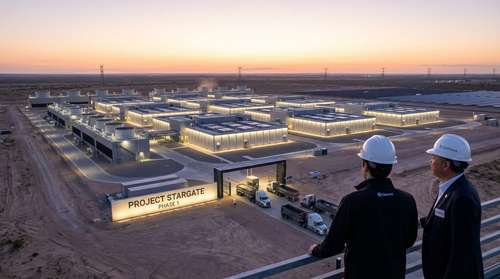
SAN FRANCISCO — In a defining moment for the future of artificial general intelligence (AGI), OpenAI and SoftBank officially announced the activation of Project Stargate Phase 1 today at the NANOG 96 conference in San Francisco. The first operational clusters of this $500 billion infrastructure initiative are now live in Texas, powered by NVIDIA’s next-generation Rubin AI supercomputer architecture. This milestone marks the beginning of the industrial phase of AI, moving beyond the era of cloud computing into what industry insiders are calling “The Forge”—a dedicated global network of AI factory data centers designed to train models exponentially more powerful than GPT-5.
The Rubin Architecture: A Quantum Leap in Compute
At the heart of the Texas facility lies the first commercial deployment of the NVIDIA Rubin AI supercomputer platform. Unveiled conceptually in 2024, the Rubin architecture (R100) has officially replaced the Blackwell series as the standard for frontier model training. According to technical specifications released during the NANOG 96 keynote, the new clusters utilize TSMC’s 3nm process and feature HBM4 memory stacks, delivering a 4x performance increase in bandwidth compared to previous generations.
“We have officially entered the Angstrom era of compute,” stated an OpenAI infrastructure lead during the announcement. “Project Stargate isn’t just about adding more GPUs; it’s about fundamentally rethinking the data center as a single, cohesive computer.” The Texas site serves as the pilot for a distributed network that will eventually scale to consume over 5 gigawatts of power per cluster—a density previously unimaginable in traditional data centers.
SoftBank’s $100 Billion “Izanagi” Gamble
The activation of Phase 1 also confirms the massive scope of the OpenAI SoftBank funding round rumored late last year. SoftBank CEO Masayoshi Son, who has long championed the arrival of artificial superintelligence, has reportedly committed over $100 billion through his “Project Izanagi” initiative to finance the hardware backbone of Stargate. This partnership effectively merges OpenAI’s software dominance with SoftBank’s capital and energy logistics capabilities.
SoftBank’s energy subsidiary, SB Energy, has been instrumental in bringing the Texas facility online, deploying a massive solar-plus-storage grid to handle the site's initial 1-gigawatt load. “The constraint on AGI is no longer silicon; it is electrons,” Son said in a virtual address to the NANOG attendees. “With Project Stargate, we are building the power plants of intelligence.”
Infrastructure for 2026 and Beyond
The launch of Phase 1 is just the opening move in a roadmap that extends through 2030. AGI infrastructure 2026 is characterized by a shift from hyperscale cloud services to these specialized “AI factories.” The Texas facility is designed to support the training of OpenAI’s next flagship model, tentatively referred to as the “Genesis” iteration, which requires compute budgets 100 times larger than those used for GPT-4.
Analysts project that trillion-dollar AI compute investment will become the norm over the next five years. The “Stargate” roadmap outlines a path to a total capacity of 10 gigawatts by 2028, potentially requiring the integration of Small Modular Nuclear Reactors (SMRs) to meet baseload demand—a strategy Microsoft and OpenAI are actively lobbying for in Washington.
The Global Race for AGI Dominance
The timing of the announcement at NANOG 96 San Francisco was strategic, placing the technical realities of the project before the world’s top network operators. By activating Phase 1 now, OpenAI has signaled that the physical constraints of building massive supercomputers—power, cooling, and interconnect latency—have been solved for the current generation.
As Project Stargate OpenAI news dominates the headlines, the focus now shifts to how quickly these clusters can scale. With the hardware live and the power flowing, the race to AGI has transitioned from a research problem to a manufacturing challenge, one that will reshape the global economy for decades to come.