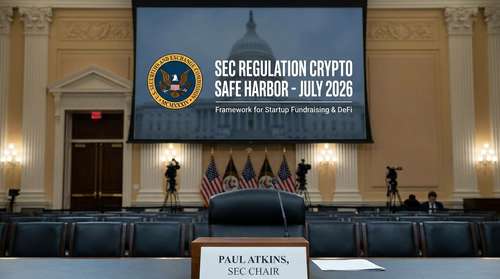

In a watershed moment that has sent shockwaves through the global financial ecosystem, the U.S. Securities and Exchange Commission has officially enacted the highly anticipated DeFi Innovation Act. Spearheaded by SEC Chairman Paul Atkins, this regulatory framework introduces a historic three-year SEC DeFi Safe Harbor, fundamentally reshaping the landscape of Cryptocurrency Regulation 2026. The landmark move officially signals the end of the agency's controversial "regulation by enforcement" era, replacing it with a structured compliance grace period that allows decentralized protocol developers to launch without the immediate threat of federal prosecution.
The A-C-T Strategy: Advance, Clarify, and Transform
For years, blockchain developers operated in a debilitating regulatory limbo. The rollout of this new framework is part of Chairman Atkins' broader "A-C-T" strategy—designed to advance, clarify, and transform domestic markets. At the heart of the legislation is a massive $75 million safe-harbor exemption aimed squarely at early-stage digital asset startups.
According to the latest Decentralized Finance news, this provision acts as a vital fundraising exemption, enabling crypto ventures to secure capital, distribute governance tokens, and progressively move toward total decentralization within a structured disclosure environment. By providing this initial runway, the SEC is actively attempting to repatriate a multi-billion dollar tech industry that had steadily migrated to offshore jurisdictions to escape regulatory ambiguity.
Establishing Non-Broker-Dealer Status
One of the most consequential aspects of the SEC DeFi Safe Harbor is its rebuttable presumption of non-broker-dealer status. Strictly non-custodial and non-discretionary front-end applications that simply interface with underlying smart contracts are no longer forced to register as traditional exchanges. The agency acknowledged that these decentralized applications do not pose the traditional agency risks—such as custody failures or conflicts of interest—that the 1934 Exchange Act was originally designed to mitigate.
Protecting Core Infrastructure and the "DINO" Caveat
While the DeFi Innovation Act is incredibly favorable for genuine builders, it does not offer a free pass to bad actors. The SEC retained aggressive enforcement authority specifically targeted at platforms identified as "DINO"—DeFi In Name Only. If a protocol claims decentralization but actively functions as a de facto centralized intermediary, it immediately forfeits its three-year safe harbor protections and remains subject to strict investor protection interventions.
To shield genuine blockchain infrastructure, the framework integrates crucial developer protections modeled after Section 15H of the Senate's CLARITY Act. Under these updated US Crypto Laws, software engineers cannot be subjected to securities registration solely for their foundational work. Protected activities now explicitly include:
- Relaying and validating transactions on distributed ledgers.
- Operating node infrastructure and pricing oracles.
- Publishing or maintaining distributed ledger software.
- Building and distributing non-custodial self-custody wallets.
Crypto Market Surge and the Latest Uniswap Price News
The regulatory clarity provided by the SEC and CFTC's recent joint memorandum of understanding has predictably triggered a massive Crypto Market Surge. Top digital asset indexes tracking the largest market-cap cryptocurrencies jumped double digits within hours of the official framework reveal. Institutional capital, previously sidelined by compliance fears, is aggressively re-entering the ecosystem.
This macro tailwind has heavily influenced the most recent Uniswap price news. As the premier automated market maker, Uniswap sits squarely at the center of the DeFi infrastructure narrative. Following the safe harbor announcement, UNI experienced a sharp perpetual short squeeze, driving its spot price up to the $3.15–$3.60 range. Traders rushed to cover their bearish bets as the overarching threat of a crippling SEC lawsuit evaporated.
Fundamentally, the protocol continues to expand its footprint. The token commands nearly 36% of the decentralized exchange volume, recently processing over $111 billion in monthly transactions. Furthermore, recent integrations, such as Uniswap's API becoming the native swap provider for Privy's wallet infrastructure, highlight deep ecosystem adoption. Analysts note that the combination of this newfound regulatory clarity and Uniswap's massive addressable market could eventually propel the asset out of its compressed multi-month trading range.
A New Paradigm for Decentralized Finance
The framework also represents the first major policy execution following the historic Memorandum of Understanding (MOU) signed between the SEC and the Commodity Futures Trading Commission (CFTC) earlier in 2026. By explicitly harmonizing agency oversight, the Joint Harmonization Initiative eliminates overlapping reporting requirements and establishes clear rules for digital assets.
The DeFi Innovation Act represents a total paradigm shift for financial technology in the United States. Regulators have essentially traded their enforcer badges for the role of market facilitators, creating a robust framework that prioritizes capital formation without sacrificing consumer safety.
As the three-year grace period begins, the focus for the industry immediately shifts from surviving regulatory risk to executing on product promises. Developers now have the runway needed to prove that trustless, open-source financial networks can operate safely at a global scale. This legislation isn't just a legal relief valve; it is the starting gun for the next major supercycle of American cryptocurrency innovation.