The Digital Asset Market Clarity Act has officially reached a make-or-break moment in Washington. After overwhelmingly clearing the House of Representatives in July 2025 by a 294-134 vote, this landmark legislation faces its ultimate test as the Senate Banking Committee weighs its advancement. At the heart of this pivotal CLARITY Act Senate review is the potential to formally end years of jurisdictional warfare and permanently secure the XRP commodity classification. With the 2026 midterm elections fast approaching, lawmakers have a narrow, rapidly closing window to cement a regulatory framework that could unleash unprecedented capital into the market. Welcome to the latest cryptovot news analysis on the legislative battle shaping the future of decentralized finance.
A Historic Turning Point for US Crypto Regulation 2026
The stakes for US crypto regulation 2026 have never been higher. Treasury Secretary Scott Bessent recently underscored the urgency in an April 9 Wall Street Journal op-ed, explicitly warning that further delays risk pushing developers and capital to overseas jurisdictions like Singapore and Abu Dhabi. Europe's MiCA framework is already operational, leaving American markets fighting to catch up.
The legislation aims to establish clear operational boundaries for trading platforms, enforce robust anti-money-laundering measures, and create safe pathways for decentralized technology to flourish. More importantly, it directly tackles the contentious SEC vs CFTC crypto bill dynamic by giving the Commodity Futures Trading Commission exclusive authority over spot markets for digital commodities, while strictly limiting SEC overreach. This push is fundamentally about national security and economic competitiveness, with former White House Crypto Czar David Sacks framing the framework as essential to "onshore the future of finance".
XRP Commodity Classification: What's at Stake?
For top altcoins, the difference between an administrative ruling and statutory law is everything. On March 17, 2026, the SEC and CFTC issued a joint final rule officially classifying XRP, Solana, and Cardano as digital commodities. While this administrative move ended years of intense legal ambiguity, the determination technically remains an interpretive release that a future administration could theoretically overturn.
The Digital Asset Market Clarity Act would make this classification permanent federal law. Ripple's years-long legal battle with the SEC laid the groundwork for this moment, and passing the legislation ensures that native tokens on decentralized networks are treated identically to traditional commodities. Market analysts at Standard Chartered project that if the bill stalls, XRP could drift between $1.50 and $2.80 through year-end. However, legislative certainty would likely tighten circulating supply and propel the token toward its prior cycle highs, riding a massive wave of institutional digital asset inflows.
Unlocking Institutional Capital
Institutional allocators require absolute statutory certainty before deploying capital at scale. We have already witnessed the power of institutional appetite; following recent spot ETF approvals, 50-day inflows surged past $1.3 billion before cooling off to under $2 million weekly amid legislative uncertainty. By cementing the token's status as a non-security, the legislation removes the single biggest regulatory objection to massive mainstream adoption. Analysts project that statutory clarity could trigger a massive short-term increase in institutional investment across major layer-1 protocols. Wealth managers simply cannot allocate client funds to assets that carry the existential risk of surprise enforcement actions.
Overcoming Hurdles in the CLARITY Act Senate Review
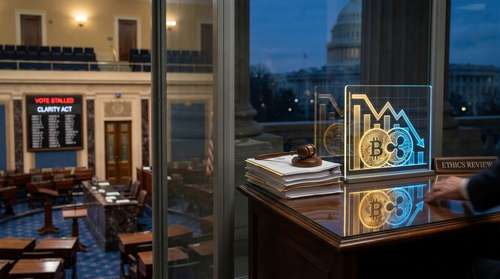
Despite strong endorsements from regulatory heads like SEC Chairman Paul Atkins, the path forward is facing severe turbulence. As of mid-April 2026, the Senate Banking Committee, chaired by Senator Tim Scott, has surprisingly pulled the bill from its upcoming schedule for the week of April 20.
This delay exposes the fragile bipartisan consensus surrounding digital finance. Controversial elements, such as how the framework handles stablecoin rewards versus passive earnings, have drawn fierce lobbying from traditional banking sectors. Banks worry that well-regulated digital assets offering yield could aggressively compete with their traditional interest and fee collection models.
If the committee fails to advance the measure before the end of May, the looming midterm election dynamics will rapidly consume the congressional calendar, effectively shelving the initiative for the rest of 2026.
The Final Push for Market Structure
The next few weeks will dictate whether the United States leads the transition into the next era of global finance or surrenders its institutional infrastructure to faster-moving nations. For investors and developers alike, all eyes remain firmly fixed on Capitol Hill. A successful markup will not only validate the persistence of the crypto industry but will permanently redefine how digital value moves across the American economy.