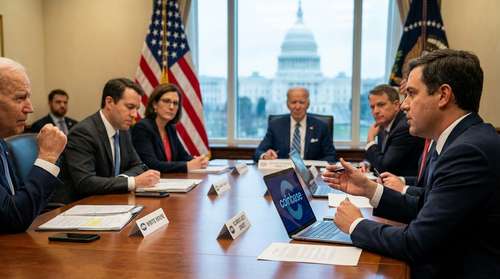
In a decisive move to break the legislative gridlock threatening the future of American digital finance, the White House has announced a high-stakes summit scheduled for this Monday, February 2, 2026. The emergency gathering will bring together senior policy executives from Coinbase, major U.S. banking institutions, and the White House Crypto Council. The primary agenda: resolving the fierce standoff over stablecoin rewards policies that recently derailed the bipartisan Digital Asset Market Clarity Act (CLARITY Act).
The White House Stablecoin Summit 2026 represents a critical intervention by the administration to bridge the widening chasm between traditional financial powerhouses and the burgeoning crypto economy. With the US digital asset regulation framework hanging in the balance, Monday's negotiations aim to forge a compromise on the contentious issue of third-party stablecoin yields—a feature banks argue threatens their deposit base, while crypto leaders defend it as a fundamental tool for economic freedom.
The Great Yield War: Banks vs. Crypto
At the heart of the conflict is the "yield loophole" left open by the historic passage of the GENIUS Act in July 2025. While that legislation successfully regulated stablecoin issuers like Circle and Paxos, it remained silent on whether third-party platforms—specifically exchanges like Coinbase—could pass rewards on to consumers.
Traditional financial institutions, represented by the American Bankers Association (ABA), have lobbied aggressively to close this gap. Bank of America CEO Brian Moynihan recently warned that unchecked institutional stablecoin adoption with high-yield incentives could trigger a massive "deposit flight," potentially draining up to $6 trillion from the commercial banking system. Banks argue that without federal caps on these rewards, they cannot compete with the 3.5% to 5% yields offered on digital dollar equivalents.
Conversely, the crypto sector views these rewards as essential for consumer adoption. The tension reached a boiling point on January 14, when Coinbase CEO Brian Armstrong abruptly withdrew support for the CLARITY Act, citing a "poison pill" amendment that would have effectively banned these pass-through yields.
Salvaging the CLARITY Act
The crypto banking framework 2026 was supposed to be finalized with the CLARITY Act, which clarifies jurisdiction between the SEC and CFTC. However, the withdrawal of industry support left the bill stalled in the Senate Banking Committee. Monday's summit is seen as the administration's "Hail Mary" to get all parties back to the negotiating table before the midterm election cycle freezes legislative progress.
According to sources familiar with the matter, the summit will be a working session focused on technical compromises rather than political grandstanding. While C-suite executives like Armstrong are not expected to attend, Coinbase will be represented by its Head of U.S. Policy, Kara Calvert, alongside counterparts from the Blockchain Association and the Digital Chamber.
Potential Regulatory Compromises
Insiders suggest the White House may propose a tiered framework to break the impasse. Potential solutions on the table include:
- Yield Caps: Limiting the percentage of yield that non-bank entities can offer to retail customers.
- Reserve Requirements: Mandating that platforms offering rewards hold 1:1 liquid reserves in Federal Reserve master accounts, similar to the requirements for Federal Reserve stablecoin guidelines.
- Banking Integration: A "safe harbor" pathway for banks to offer their own competitive stablecoin products without punitive capital requirements.
The Stakes for U.S. Crypto Dominance
The outcome of this summit will likely dictate the trajectory of the U.S. digital economy for the next decade. If a compromise is reached, the CLARITY Act could pass the Senate by spring, cementing the U.S. as the global jurisdiction of choice for digital assets.
"We are at a do-or-die moment for American crypto competitiveness," said a spokesperson for the Digital Chamber. "If we let the yield issue kill the CLARITY Act, we surrender our lead to Europe and Asia, where frameworks like MiCA are already fully operational."
As Monday approaches, all eyes are on the West Wing. The administration's ability to broker a peace treaty between Wall Street and Silicon Valley will determine whether 2026 is remembered as the year crypto officially merged with the global financial system—or the year the two drifted permanently apart.