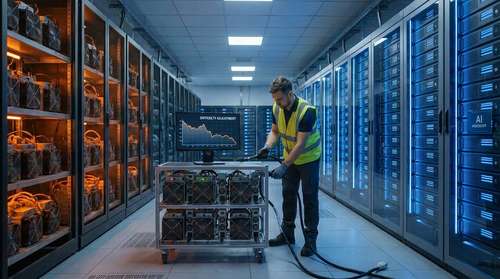
The Bitcoin network has officially breached the historic Zettahash barrier, securing the ledger with over one sextillion hashes per second as of January 11, 2026. While this milestone marks an apex in Bitcoin network security, it arrives amidst a brutal profitability squeeze for traditional mining operations. In a survival-of-the-fittest pivot, leading North American miners have secured over $65 billion in AI data center contracts, fundamentally transforming the economics of the crypto sector.
The Zettahash Era: 1,000 Exahashes and Counting
As of this week, the global Bitcoin zettahash hashrate holds steady above 1.04 ZH/s (1,046 EH/s), a figure that seemed aspirational just two years ago. This exponential growth in computational power has pushed mining difficulty to a record 146 trillion, crushing margins for operators solely reliant on block rewards. With the hashprice hovering near meager lows of $40 per petahash/second, the "Zettahash Era" has become a double-edged sword: the network is impregnable, but pure-play mining is increasingly a game of diminishing returns.
"We are seeing a bifurcation in the industry," notes a recent analyst report from CoinShares. "The hashrate growth proves miners are deploying faster, more efficient fleets like the Antminer S21 and S23, but the real revenue story has shifted to High-Performance Computing (HPC)."
The Great AI Pivot: $65 Billion in Contracts
Facing post-halving economics, public miners have aggressively pivoted infrastructure to support the booming artificial intelligence sector. By late 2025, these companies had announced a cumulative $65 billion in AI data center contracts. This crypto mining AI pivot is no longer an experiment—it is the primary lifeline for the industry's biggest players.
The math is undeniable. While traditional Bitcoin mining generates volatile returns tethered to spot prices, AI hosting contracts offer stable, long-term revenue averaging $1.5 million to $2 million per megawatt annually—nearly triple the revenue per megawatt of traditional mining. Companies that have successfully transitioned are projected to see non-mining revenue account for up to 80% of their operating income by the end of 2026.
Core Scientific and the CoreWeave Effect
Leading the charge is Core Scientific (CORZ), which has set the industry standard for Core Scientific AI contracts. Following its massive multi-year agreement with hyperscaler CoreWeave, Core Scientific has locked in nearly $8.7 billion in total projected revenue. The firm's ability to retrofit gigawatts of power capacity for HPC workloads has made it a blueprint for the sector's evolution, proving that power capacity—not just hashrate—is the ultimate asset in the 2026 digital economy.
TeraWulf Leads High Performance Computing Charge
Investors tracking TeraWulf stock news 2026 have witnessed a breakout start to the year. The company (NASDAQ: WULF) surged over 20% in early January after securing $1.3 billion in financing to expand its Abernathy AI data center. Partnering with Fluidstack and backed by Google-supported credit structures, TeraWulf is rapidly deploying high performance computing mining infrastructure that runs alongside its zero-carbon Bitcoin operations.
TeraWulf’s strategy highlights the new industry archetype: the "hybrid" miner. By utilizing excess power for Bitcoin mining during off-peak demand while dedicating premium uptime to AI inference and training, these firms are maximizing the value of every electron.
ETF Performance and Investor Sentiment
This structural shift is reshaping how Wall Street accesses the sector. The WGMI mining ETF (CoinShares Valkyrie Bitcoin Miners ETF) has seen its holdings rotate heavily toward these AI-hybrid models. Top weightings now favor companies like Iris Energy (IREN), Cipher Mining, and TeraWulf, which offer exposure to both Bitcoin's potential upside and the secular growth of Generative AI.
For investors, the signal is clear: in 2026, the strongest Bitcoin miners are actually data center powerhouses. As the Zettahash era grinds down inefficient operators, the giants securing billions in AI contracts are the ones poised to dominate the next cycle.