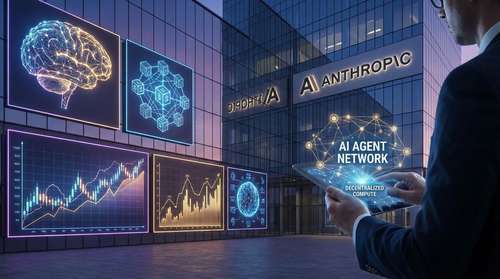
In a watershed moment for the global technology sector, Anthropic has secured a historic $30 billion Series G funding round, catapulting its post-money valuation to a staggering $380 billion. This valuation, confirmed on February 12, 2026, not only cements Anthropic's position as a titan of the generative AI landscape but also signals a definitive market shift toward autonomous AI agents. As these agents evolve from passive chatbots to active economic participants capable of executing complex workflows, they are fundamentally rewriting the rules of digital infrastructure, creating an insatiable demand for decentralized compute networks and integrating deeply with AI crypto infrastructure.
The $380 Billion Signal: Agents Are the New Economy
The massive capital injection, led by sovereign wealth fund GIC and Coatue Management, with participation from D.E. Shaw and other heavyweights, is more than just a vote of confidence—it's a capital allocation shift of historic proportions. With annualized revenue reportedly hitting $14 billion—a tenfold increase year-over-year—Anthropic has proven that the market is hungry for more than just conversation. The driver of this valuation is the company's aggressive push into agentic AI technology, specifically through tools like Claude Code and its advanced "Computer Use" capabilities.
Unlike traditional SaaS platforms that charge per seat for human tools, Anthropic's new valuation reflects a future where AI agents perform the work itself. Investors are betting that autonomous AI agents will become the primary consumers of digital services, effectively rendering the old "software-as-a-service" models obsolete. This transition is already being felt across Silicon Valley, with analysts dubbing the disruption a potential "SaaSpocalypse" as enterprise spending shifts from human-centric tools to agent-centric execution layers.
Connecting the Dots: AI Agents and Crypto Infrastructure
One of the most profound implications of this "agentic era" is the rapid convergence of AI and blockchain technologies. As AI agents begin to autonomously negotiate resources, pay for API calls, and execute transactions, they require a financial rail that is permissionless and programmable. This is where AI crypto infrastructure becomes critical. Traditional banking rails are too slow and gated for high-frequency, autonomous agent transactions.
The Rise of Agentic Wallets
Coinciding with Anthropic's ascent, major crypto players like Coinbase have launched specialized Agentic Wallets designed specifically for AI counterparts. These wallets allow agents to hold funds (like USDC) and transact on-chain without human intervention. This development bridges the gap between Anthropic's intelligent models and the blockchain AI integration needed for them to operate in the real economy. For the first time, an AI model can technically "hire" another AI, pay for storage on a decentralized network, or arbitrage compute resources in real-time.
Decentralized Compute Networks: The Engine of 2026
The explosion of agentic workloads has placed unprecedented strain on centralized cloud providers. Anthropic valuation 2026 metrics suggest that centralized data centers alone cannot sustain the inference costs of billions of autonomous agents operating 24/7. This bottleneck has become the primary catalyst for the adoption of decentralized compute networks.
These networks, often incentivized by crypto tokens, allow for the distributed processing of AI workloads. As Anthropic's Claude 3.7 Sonnet and Opus 4.6 models demand massive inference power for their "extended thinking" and coding tasks, decentralized grids offer a scalable, cost-effective alternative to AWS or Google Cloud. The narrative has shifted from "crypto for speculation" to "crypto for compute," with the $380 billion valuation serving as the ultimate validation that the infrastructure must scale to meet the needs of a non-human workforce.
Redefining Business Processes with AI-First Logic
The implications for enterprise are stark. We are witnessing the birth of AI-first business processes where the human is looped out of the execution phase. Anthropic's Claude Code tool, which can autonomously navigate codebases, run tests, and deploy fixes, is a prime example. In this new paradigm, a business doesn't just hire a developer; it deploys an agent that runs on a decentralized network, pays for its own compute with crypto, and delivers finished code.
This shift explains why investors are willing to value Anthropic at nearly $400 billion. They aren't just buying into a chatbot; they are buying into the operating system of the future autonomous economy. As blockchain AI integration matures, we can expect to see entire corporate departments—from accounts payable to cybersecurity—replaced by fleets of agents that operate transparently on-chain, auditable by code rather than accountants.
The Road Ahead: A New Digital Fabric
Anthropic's record-breaking valuation is the starting gun for a new technological epoch. The convergence of agentic AI technology, decentralized finance, and distributed computing is creating a new digital fabric. In this world, the primary users of the internet will not be humans scrolling feeds, but agents executing tasks.
For investors and technologists alike, the message is clear: the infrastructure of the last decade is being dismantled. The future belongs to those who build the rails, the compute, and the intelligence for the agentic economy. As Anthropic pushes the boundaries of what AI can do, the crypto and decentralized web communities are finally finding the "killer app" they've been waiting for: the autonomous agent.